Leïla:    Larissa Yudina
Nadir:    Brian Stucki
Zurga:    David Adam Moore
Nourabad:    Patrick Carfizzi
Principal Dancers:    Bobby Briscoe,    Lisa Gillespie
Conductor:    Gerard Schwarz
Stage Director:    Kay Walker Castaldo
Lighting Designer:    Neil Peter Jampolis
Choreographer:    Peggy Hickey
Sets and costumes:    Philadelphia Opera (Boyd Ostroff, Richard St. Clair)
Simple yet effective stage sets. Sophisticate lighting imitates water and diving. Better dancing numbers than most. Both Nadir and Zurga went shirtless, and they looked great (probably lots of workout during the past half year). Leila needs to loose some weight. But her voice is superb.
Monday, January 26, 2009
2009.1.23. "Pearl Fisher" at Seattle Opera
Pearl Fisher at Seattle Opera.


Tuesday, January 20, 2009
2009.1.19. "Road to Mecca" at Seattle Rep
2009.1.19. Road to Mecca by Athol Fugard at Seattle Repertory Theatre. Inspired by the life of Helen Martins, the play only depicts one afternoon visit by a friend who lives 800 miles away, and a pastor in the same town. It managed to touch various subjects: self independence, aging, trust ..., and done so very well. Quite moving. Fantastic stage set: all these candles ...
Friday, January 09, 2009
2009.1.4-8. Stuck in Milan
 Milan is a vibrant city inhabited by real locals, despite large amount of tourists (some just to use the airport, most are here shopping), orderly, fashionable.
It is here in 313, Constantine I and Licinius issued Edict of Toleration for Christianity.
 Milan's Duomo is absolutely amazing. The # of spires and statues are mind boggling. To better appreciate this, take the elevator €8 or walk €5 (at the opposite end of the cathedral) up to the top. Even though the roof terrace was closed due to the freezing weather, this is a must do to get up and close, to be overwhelmed. One of the largest in the world, built from 1386 until Napoleon. Just look at the 5 giant front doors, each from a different era. 5 naves, divided by 40 pillars, each guarded by a saint statue on top. Magnificent stain glass windows, paintings on walls, and tombs under foot. €1 to the crypt should be avoided. Across the west end (close to the main entrance), a brass line on the floor functions as a sundial installed in 1786. Signs of zodiac were probably added later. A nail from Christ's cross is supposed to be hanging high somewhere. Canals (some still left - Naviglio: a nice neighborhood) were dug to reach river Ticino, then to Lake Maggiore, in order to transport the marbles quarried Candoglia mountains near Novara.
 A major tourist attraction is Last Supper by Da Vinci in Santa Maria delle Grazie. Da Vinci's fading fresco and another less faded were the only thing to see for €6.5, for 15 minutes, no more no less. The visit is by reservation only, up to a 15 minute slot, each allows 25 spectators. Now, all reservation is filled to 2-3 weeks ahead. In summer time, maybe months ahead. But on a snowy day like this, plenty cancellation for anyone to squeeze in. What a disappointment (even though I expected to be disappointed)! The church itself is quite lovely.
San Ambrogio named after Milan's patron saint San Ambrose. Also reconstructed after WWII bombing, this retained its Lombardy perfection, using salvaged original materials. Charming columned portico, dated to the 15th century. Most part appeared Romanesque (various redesigns in 9-11th century. The remain of its first basilica dated to late 300s. San Ambrose together St. Gervasius and Protasius are sleeping in a glass case.
San Satino, buried among busy shopping street: via Torino. It is dedicated to Saint Satyrus, confessor and brother of Saints Ambrose. Check out the interior dome.

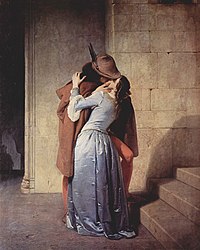 Brera (€5, closed on Mondays like all other museums ) is a minor disappointment. The building looks like a construction site. Each room has information brochures under a sign in both English and Italian "Please return here", but the brochures are all in Italian. The only Raphael is being restored. At least they are nice enough to enclose part of the exhibition room with glass panels, so you can see it. Hayez' Il Bacio is also prominently advertised. Many paintings here are of monumental scale.
Castello Storzesco, a 15 th century castle. The splendid grounds open daily, as is the information office. Now 5 museums occupy various buildings inside the wall. Behind it is a large city park and another Napoleon's arch, a peace arch. At the moment, 2 ice inclines were set for kids to learn ski. Loudspeakers were cranked high.
Manzoni's house is closed on all holidays, weekends and Mondays (so Jan 3th - 6th).
Milan seems to be a shopping haven. Everyone was carrying colored gift bags. The Galleria is gorgeous, connecting Piazza del Duomo and Piazza della Scala. It's almost inevitable to pass through it a few times a day. The entire glass dome was glittering with blue lights. Under it, a small crowd was circling around the Turin Bull. Piazza della Scala was "adorned" with 4 giant red Medusa-like clay heads. The streets around that and Duomo are lovely for walking. The wide pedestrian street, via Dante, between Cordusio and the castle was full of people and their shopping bags. Most foreigners go to Quadrilatero d'Oro - 4 adjoining streets north of Duomo: Via Montenapoleone, Della Spiga, Via Borgospesso, and Via Sant'Andrea, lined with Milan's most expensive high-fashion emporia.
Snow started falling Monday (Jan 5th) evening, continued until the evening of Jan 7th. All flights were canceled! Painfully slow lines at the airport to rebook all seats, at the same time, airport services were shutting down.
€7 bus to the airport (or €12 return) by bus from the central train station. 1 hour journey. Every 20 minutes. €11 by train. Urban transportation is €1 for 70 minutes, €3 for a day, €5.5 for two days. Very reasonable.
More varieties of food. Cheap too, especially wine and cheese. I saw wine started at 97c in a supermarket.
Sunday, January 04, 2009
2009.1.4. "Don Carlos" at La Scala
Don Carlos at Teatro alla Scala. A new production, 4 acts, most with a scene change in the middle, over 4 hours. Marvellous voices, big orchestra (9 cellos and 9 bases, just to name a few!), huge voice ensemble (as many as ~60 people some points), deep stage (allows two different sets for foreground and background). Simple, geometry stage set that doesn't vary much. The beginning scene for the monks' cells is white with black doors, reminding me of a row of toilet stalls.

 La Scala offers 140 standing tickets before each show for just €5. I was late for 5 minutes because I needed to pick up my prepaid ticket (€37 + €7 reservation fee) which wasn't even there. Had to wait standing on the 2nd gallery floor until the first scene change, ~20 mins, while someone was happily sitting in my seat. Quite full, most guests dressed up nicely. The girls who work as docent here are as beautiful as fashion models.
Being one of the most renowned theatres, La Scala's building is a bit disappointing. Reconstructed (1946) after the WWII bombing, it seemed hastily built without too much fund. Decor is true to its old self, but lack in detail and refinement. Red, velvety. 2000+ seats: 4 floors of boxes, 2 floors of gallery each with 2 rows and standing room. Thanks to the 2001 renovation, an electronic libretto system was install. The little screen in front of every seat can be tilted to match the eye level and offers text in two languages. A prominent yet non-intrusive display on the top of the stage shows time with hours in Roman numeral and minutes in 5-min increment.
Conductor: Daniele Gatti
 Concert Master: Bruno Casoni
 Staging and Sets: Stéphane Braunschweig
 Costumes: Thibault van Craenenbroeck
 Lights: Marion Hewlett
 Philip II: Ferruccio Furlanetto
 Don Carlo: Stuart Neill
 Rodrigo: Thomas Johannes Mayer
 The Grand Inquisitor: Matti Salminen
 Elisabeth de Valois: Fiorenza Cedolins
 Princess Eboli Dolora Zajick: Anna Smirnova
 La Scala offers 140 standing tickets before each show for just €5. I was late for 5 minutes because I needed to pick up my prepaid ticket (€37 + €7 reservation fee) which wasn't even there. Had to wait standing on the 2nd gallery floor until the first scene change, ~20 mins, while someone was happily sitting in my seat. Quite full, most guests dressed up nicely. The girls who work as docent here are as beautiful as fashion models.
Being one of the most renowned theatres, La Scala's building is a bit disappointing. Reconstructed (1946) after the WWII bombing, it seemed hastily built without too much fund. Decor is true to its old self, but lack in detail and refinement. Red, velvety. 2000+ seats: 4 floors of boxes, 2 floors of gallery each with 2 rows and standing room. Thanks to the 2001 renovation, an electronic libretto system was install. The little screen in front of every seat can be tilted to match the eye level and offers text in two languages. A prominent yet non-intrusive display on the top of the stage shows time with hours in Roman numeral and minutes in 5-min increment.

Saturday, January 03, 2009
2009.1.1-3, New Year in Florence
 Firenze.: an almost lovely city infested by tourism. Handsome Renaissance buildings and medieval streets, endless Madonnas and baby Christs. Many residents (native or immigrants) and the city government thrive on taking advantage of the tourists, which leaves a sour taste sometimes. The tourist information booth at the train station sells the free tourist map for €1. Cover charge + service charge in restaurants, €4 reservation fee for museums, hefty fines every time you pass into "Zona Traffico Limitato". Peddlers in the market who cheat ... Except for my little hotel, who went out of the way to help their customers. The grandpa cut a plug and used duct tape to make me a temporary outlet converter.
 My favorite museum is Pitti Palace south of river Arno. Ticket #1: €12 - gallery and apartments; ticket #2: €10 - garden, costumes and jewelry. Closed Mondays.
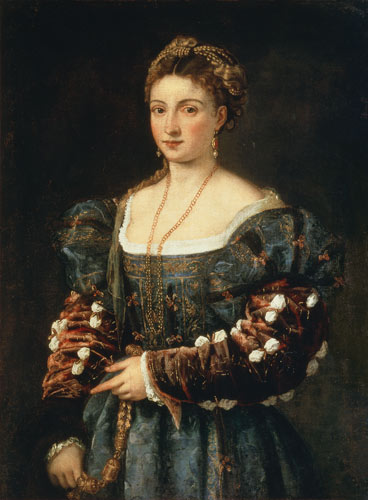
  No lines. Home to the Medicis for ~200 years. Imposing yet austere facade. Expansive Boboli garden lined with statues and fountains. Each room of the Palatine Gallery and Royal Apartments has information brochures in either Italian and English, describing the function of the room and every object in the room, with more notable pieces listed in red. The Palatine Gallery is not to be missed. Lavishly decorated by Pietro da Cortona. It was to inspired Le Brun for Vaux-le-Vicomte and later Versailles, long before it was finished. Each room has a theme denoted by its ceiling fresco. Every wall is stacked with paintings from the ceiling to the floor, including the top of the doorways, arranged to the taste of its former user, with no particular order. 11 by Raphael and 10 by Titian, arguably their best, 16 Andrea del Sarto, 4 Tintoretto, 6 Rubens, 2 Vandyke, 2 Murillo, 2 ugly Botticelli. Roman statues, French vases and clocks. Better and larger collection than Uffizi, in my opinion. I especially like those marble tables with intricate precious stone inlay tops. The Royal Apartments are more recent, equally Sumptuous, more velvet than paintings. The Modern Art Gallery on the top floor is not to be ignored. 30 Baroque rooms exhibits 19th to early 20th century Italian paintings. For example: 60+ Fattori (temporary?), Ussi, Nomellini.
    |
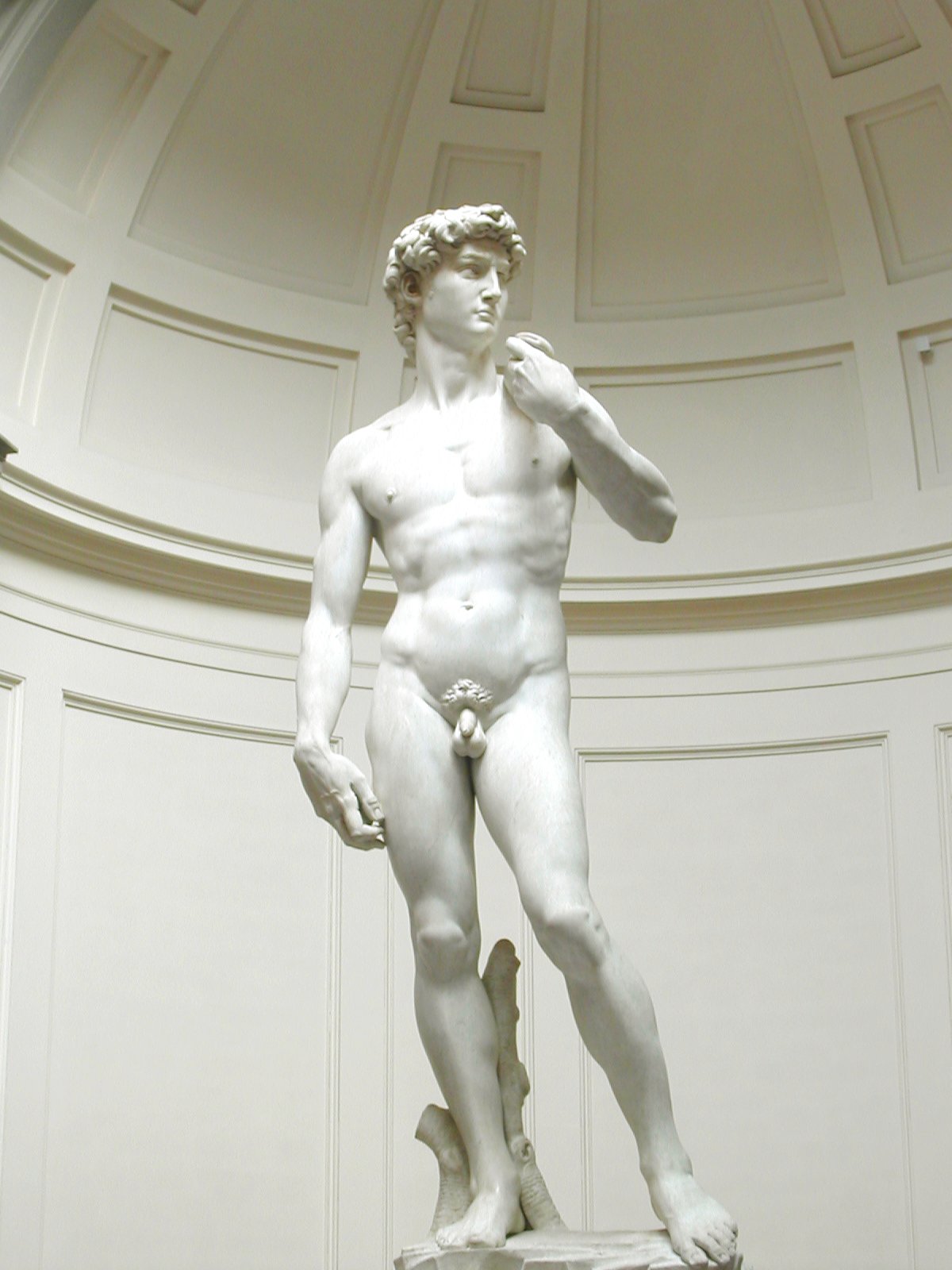 Art Academy Gallery (€6.5) has a short line. It houses prize winning/attempting submissions and clay models by art students throughout the years, along with a few by more well known giants (e.g. 2 Madonnas by Botticelli). David is impressive (watch the vein on the back of his hands). After nearly 400 years of weathering, David is cleverly displayed under a dome, like on an altar, at the end of a corridor lined with unfinished sculptures by Michelangelo. Interesting to see how forms emerge from a cold block of marble. There's a computer screen to show every angle of David. A small room at a corner exhibits some music instruments collected by the Medicis + two small models showing how harpsichord and piano work. Walking upstairs, you'd see a collection of Russian icons on the wall. Upper floor exhibits boring medieval Jesus paintings on wooden panels collected from various churches. A girl explains how egg tempera was applied in those days - that's quite informative.
 Uffizi (€6.5) is so hyped up that the lines could be 3+ hrs.
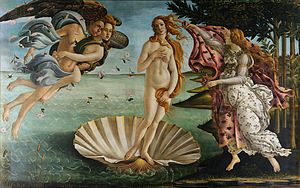
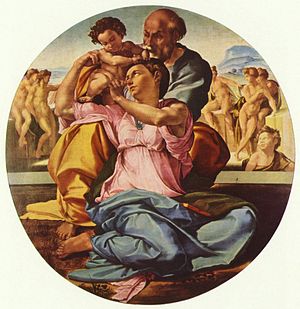
  Even with advanced timed reservation, there was a line. By showing up at the door at 7:45am, I was able to get in by 8:30am sans reservation. The best of this museum is the view over Arno and its bridges. A small collection (2nd floor only), most notably for Botticelli's Venus in the half shell and Spring, Titian's Venus of Urbino, a couple of Caravaggio's, 3 so-so Raphael's, 2 bad Da Vinci's, and a rare non-fresco painting by Michelangelo: Doni Tondo. Botticelli is the biggest draw, but his paintings lack proper 3D and rich color, unlike the late comers. Outside, in the U shape courtyard is the "hall of fame": statues of Lorenzo the Magnificent, Giotto, Donatello, Alberti, da Vinci, Michelangelo, Dante, Petrarch, Boccaccio, Machiavelli, Vespucci, Galileo.
  |  |
 |  |
 North of Uffizi is Piazza della Signroia, the center. Lively, overwatched by Plazzo Vecchio (the powerhouse). A lovely loggia at the end of Uffizi was once the public forum, now stands some large worthy sculptures. A plaque on the ground a few steps in front of to the Fountain of Neptune commemorates where Savonarola was defrocked and burned.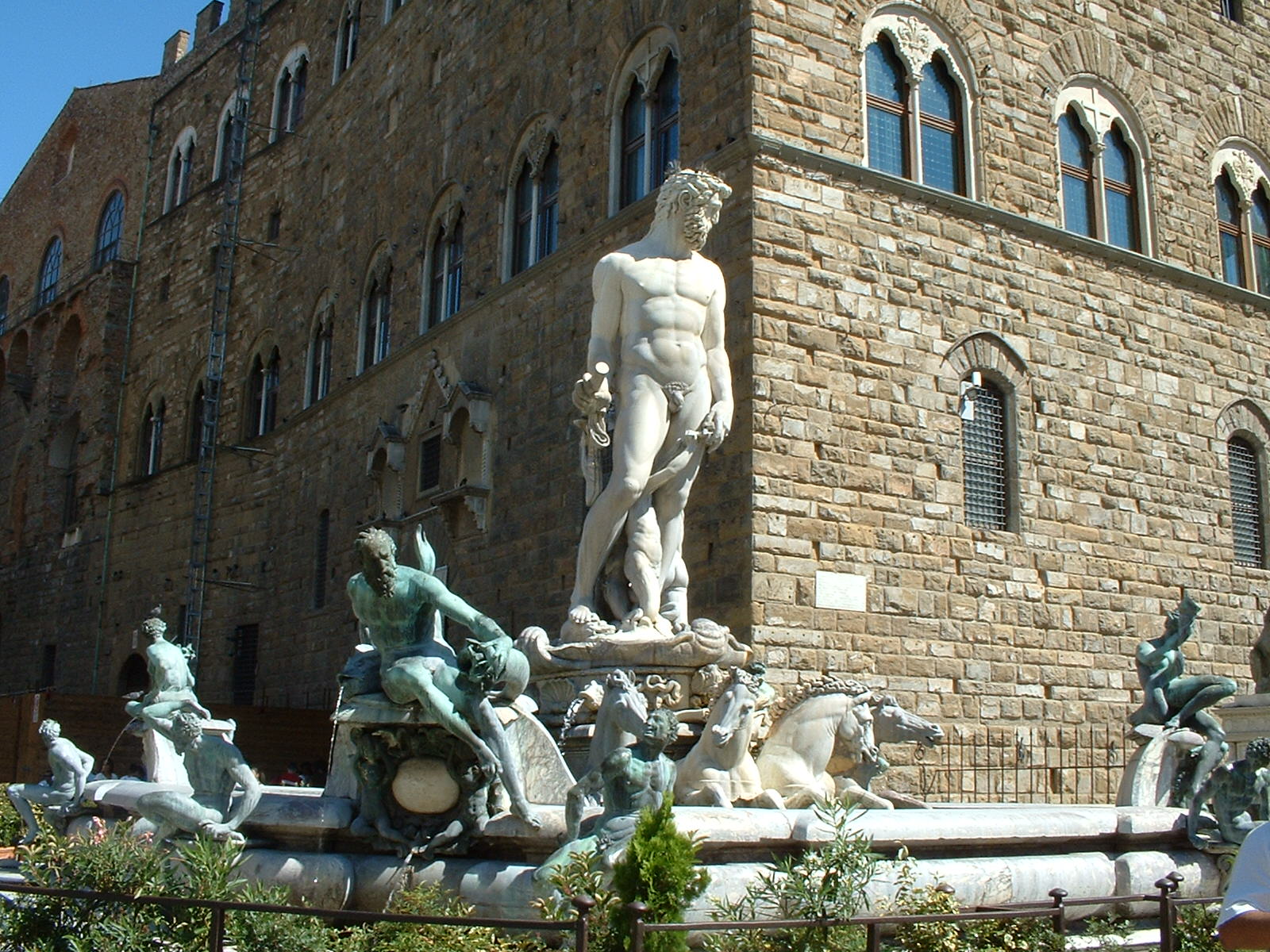
South of Uffizi passing Vasari Corridor is Ponte Vecchio, a famous bridge lined up with jewelry shops.
 Bargello is a small sculpture museum. Quite boring. The building has more character: a former barrack and police station, built in 13thcentury. A Donatello room, including the competition entries by Ghiberti and Brunelleschi for the Baptistery Door, side by side. A slightly larger room a few bigger sculptures including 3 by Michelangelo. 2nd floor is dinnerware, so-so jewelry, and colorful terracotta panels of Mary and baby. 3rd floor is armory.
Other civic places one can visit are Science History Museum, Michelangelo's House, Palazzo Davanzati (free), Palazzo Strozzi (now host temporary exhibitions on two different floors), Palazzo Medici-Riccardi, Piazza della Repubblica (site of original Roman Forum). The iron-glass central market (closed at 2pm, and on Sundays) near the train station, and the flea-like market around San Lorenzo (Medici's burial place), selling South American leathers and other tourist trinkets.
 Duomo, built in 1296-1436, is impressive, but only the outside. The Duomo complex also includes Giotto's elegant Campanile 1435, and Baptistery 1059 - 1128 (notable for its magnificent mosaic ceiling and the 12 bronze panels on the door, 3 of which was exhibited in Seattle Art Museum less than a year ago). Rather empty inside except for the giant painting (1572-9) on the dome ceiling, which you can only see if you walk to the top of the Brunelleschi's dome (€8, quite a line, closed on Sundays), so you must.


 Santa Croce (€5, closed Sunday till 13:00, can enter from the leather school at the left end for free) holds tombs of Michelangelo, Galileo, Machiavelli, Ghiberti, Rossini among many others. A statue of liberty stands by the door, breaking her chain (tomb of Giovanni Basttista Niccolini).


 A rumpled part of St. Francis' tunic and a Papal Bull that legitimized Franciscan are displayed in a glass case along the right wall in the sacristy at the right end. A Donatello bronze, fabulous stain glass windows, many impressive frescoes (including the entire far end wall of the refectory: Tree of the Cross by Gaddi), a status of liberty. The elegant Pazzi Chapel and cloister was by Brunelleschi.
 San Marco (€4) merits a quick visit, home to the religious lives of Fra Angelico, Savonarola, Fra Bartolomeo, and Cosimo de Medici when in a retreat mood. Monks lived on the upper floor. Fra Angelico painted its many walls including ~half of the cells. The end of this corridor in the left picture is Savonarola's cell. Extremely simple, 3 tiny rooms feels more like caves.
My favorite church is San Miniato al Monte. Free. Situated on the top of the hill south of Arno. View of Florence is fantastic. Mosaic altar ceiling. Not a small cemetery. Some of the tombs are elaborate, almost like a reduced Duomo. Many people stop at the large Piazzale Michelangelo centered around a giant David, which offers free parking. Even in this cold afternoon, just after the rain, at least two wedding groups were taking photos.
Orsanmichele. Free. A grain market in the 1300s (was an open loggia, with warehouse upstairs). Interestingly medieval but civil. Statues filled the niches on the outside wall (2 by Donatello), some decorated with sign the guilds who paid for the work.
A short bus (30 mins, every 20 mins) ride takes you to Fiesole, for cooler weather and a grand view of the Arno valley (walk up via San Francesco). Passing by vineyards and former villas, you get to see the dry climate: most vegetation is brushes and trees with small leaves. A sleepy little Etruscan town, hard to imagine its former power which rivaled Florence.
Subscribe to:
Posts (Atom)