Saturday, December 10, 2011
2011.12.10. Snowshoe to Source Lake at Snoqualmie Pass
Drizzle in Seattle. Cloudy but with sun breaks at the pass. Not too many people skiing at Apental. No wait for the lifts. Compact snow all the way. I carried my borrowed snowshoes until above Source Lake. There, snow was fluffy and lovely. Some were hiking up the steep cliff at the end of the valley here and then skied down.


Friday, December 09, 2011
2011.12.9. Luis Alberto Urrea talks at Elliott Bay Bookstore
Urrea is very funny and an exceptional story teller. He didn't just read a segment of the book, he was acting. It's fun to watch and listen. He was here promoting his new book Queen of America. He claimed that all the characters are real, and showed us photos of them. Of course, other stories related or not-related to the books.
Wednesday, November 30, 2011
2011.10.25-11.29 SE Africa (part 8/8) - summary
Highlights 
Packaged tour vs. independent travel
Packing
I pack light. Only carried these 2 day packs. Tent and mattress were provided by the tours. Since I didn't bring many clothes, I had to do laundry very often. Towards the end of my trip, I threw away dirty laundry. What I brought that's recommendable:
Money
Health
Yellow Fever vaccination is required to enter Tanzania and Zanzibar.
None of my fellow tourist had food poisoning.
Language
Most people speak good English. But it's impossible to understand what they speak to each other. South Africa alone has 11 official languages!
Food
Boring. Only a few variates of fruit, vegetable available in grocery stores. Banana, mango, pineapple are prevalent, and tasty. Often times, there's nothing else. Tomato is awful. Cabbage can be the only vegetable sometimes.
Meat: chicken and beef. Fish, goat, donkey sometimes. Often cooked to death. Crocodile and ostrich is available in restaurants (not in grocery stores), farmed. Game is hard to come by. Kenya has outlawed game meat. I was told in Namibia, it's possible to try zebra and warthog.
Power plug
South Africa and Botswana use the same strange plug. The rest uses UK plug.

- I love Chobe and Serengeti/Ngorongoro for game viewing at the time of my arrival (early-mid November). If a month or more earlier (in dry season), Masai Mara in Kenya should be a better option than Serengeti, because the grand migration of wildebeest would still be in Masai Mara. Also, vehicles are allowed to drive off road in Masai Mara, so potentially closer to animals.
- Lake Nakuru and Bogoria are better in dry season, but can get very hot.
- Victoria Falls are better in wet season, but peak flow may obscure the view. Devil's Pool is close when water volume is too high.
Packaged tour vs. independent travel
- For independent travelers in Africa with an RV, I found this site contains a lot of useful information. Without a vehicle, packaged tours provide safety, companionship, logistics, and economical solution. Public transportation is only good between big cities. Most game parks charge exorbitant fees for vehicle entrance, and no walk-ins allowed.
Packing
I pack light. Only carried these 2 day packs.
 Tent and mattress were provided by the tours. Since I didn't bring many clothes, I had to do laundry very often. Towards the end of my trip, I threw away dirty laundry. What I brought that's recommendable:
- 1 thin sleeping bag. Most nights, too hot to use it. At cold nights, I wear all my clothes in the sleeping bag.
- 1 small cashmere sweater, 1 thin fleece with hood, 2 ponchos for rain.
- 1 pair of long pants, 2 pairs of shorter pants longer than knees (for Muslin area).
- 2 long sleeve shirts, 4 T-shirts.
- swimsuit, snorkeling mask.
- 1 pair of mud friendly shoes, 1 pair of sandals.
- head lamp (an absolute must), steripen (I drank tap water).
- Washing line, 3 clips, soap, shampoo (needed more), toothpaste (needed less), floss, some toilet paper.
- unmatched socks and unwanted underwear (to be threw away).
- notebook, pen, wikipedia notes of each stop, books (Thanks, Alex, for giving me her book).
- ITouch with apps like an African map, phone call, audio books (not very useful).
- A USB flash drive to duplicate the photos with borrowed computer.
- Eye mask + ear plug
Money
- I brought $1000 cash. Needed another ~$450, even though I am very frugal, didn't buy any snacks or souvenirs. Two tours $1500 + $1800. ~$1250 air fare. Vaccination + medicine ~$400 before arriving in Africa. Total ~$6400.
- ATM works in most cities. US$ is the easiest currency to exchange. Some countries give higher rate for $50 and $100 notes, and don't accept $1 note.
- Traveling alone is more expensive but flexible. I couldn't share taxi or tour costs with others.
- Parks in Africa are expensive, on average ~$50 each day, often in US$.
- Visa is often US$ cash only.
- Public transportation is cheap, but is only available between towns. When bargain, start at 20%. Beers range from 50c to $1.2 each bottle in the not-very-cold fridge.
Health
Yellow Fever vaccination is required to enter Tanzania and Zanzibar.
None of my fellow tourist had food poisoning.
Language
Most people speak good English. But it's impossible to understand what they speak to each other. South Africa alone has 11 official languages!
Food
Boring. Only a few variates of fruit, vegetable available in grocery stores. Banana, mango, pineapple are prevalent, and tasty. Often times, there's nothing else. Tomato is awful. Cabbage can be the only vegetable sometimes.
Meat: chicken and beef. Fish, goat, donkey sometimes. Often cooked to death. Crocodile and ostrich is available in restaurants (not in grocery stores), farmed. Game is hard to come by. Kenya has outlawed game meat. I was told in Namibia, it's possible to try zebra and warthog.
Power plug
South Africa and Botswana use the same strange plug. The rest uses UK plug.
2011.11.25-29. SE Africa (part 7/8) - Kenya
Visa US$50 (holiday) / $20 (transit) / free for eastern African countries. $1 ~= KSh 90.
Lake Nakuru & Lake Bogoria
Day 32 Nov. 25. Nairobi - Nakuru. Friday. Rain, sun, rain.
5:45 am breakfast. Managed to pack in pouring rain and depart at 7:20, 40 minutes behind schedule. A long line at the border. Many people (including 2 elderly Aussies) cut in line. Toilet at the border post is Tsh 200, Ksh 50 (expensive on the Kenya side). Arrived at Nairobi ~3pm in heavy traffic. At two jammed cross sections, many large birds (heron-line at one, vulture-like at the other) perched on trees.
Arrived at Boulevard Hotel ~3pm. Got a map printout at the reception. Said goodbye to my fellow GAP tourists at the Boulevard Hotel, left an envelope of $100 tip to Ang & David, and walked with my 2 bags to River Road. ~20 minutes in sun. Two ladies with perfect English helped directing me. Took 2NK matatu 1 to Nakuru (Ksh 400), hoping to visit the lakes in the Rift Valley. The minibus filled up quickly (10 seats), but took awhile to maneuver out of where it was parked (jammed), and took longer to get out of the city. Maybe it's just the Friday rush hour. Once out of the city, it ran smoothly into the rain. The young lady next to me let me place one bag in front of her legs. She then returned to her English novel.
Arrived at Nakuru city's matatu station @6:45pm (about 160Km, 2.5 hours). Dark and raining, full of people. Bought a Sim card Ksh50, but didn't know how to activate it. The friendly receptionist at Avenue Hotel called my hostel for me, which doesn't seem to exist. No one has heard of this hostel. The guy answered the phone, Moses, came ~1 hour later, and claimed that the hostel is packed, and then called other homes to put me up. Pega Tours 2 happens to run a home stay business and I was to room with a Japanese girl Yuri, even though my booking was for a private room. So, over 2 hours later, I arrived at a nice 2-story house with balcony in the outskirt of town. The lady of the house, Eileen, invited me to dinner (beef bone stew, bean stew, cabbage, rice) and then charged me Ksh 1000 for the bed, even though my booking of a private room was Ksh 700. Too late to change. Other boarders were 2 Swedish girls doing preschool research, a British lady, Patricia, volunteering at a construction project. I was the only tourist. Two servant girls, and some relatives in the same house. TV was on almost all the time. Mostly in English. To me, it turned out very nicely. Got to know a real Kenyan family, and learn more about Kenyan people.
Day 33 Nov. 26. Saturday. Rained until ~4pm.
Up ~7am. All was quiet until 8am. Had 1 egg, toast, bananas for breakfast.
Went to Pega Tour's office with Peter, Eileen, Pat and a relative. No tour is leaving today. Pat showed me the main buildings of the small town, and her Internet cafe, before meeting her Swahili teacher. I then wandered around the town, and left my phone # to 2 travel agencies. Internet is only Ksh 1/minute or less. Took some cash from ATM 3.
Hopped on a piki-piki 4 to Nakuru park entrance. Just 4km south of town. Lake Nakuru is on the UNESCO tentative list. After a lengthy security check, I was turned back. A vehicle is required to visit the park. Paid Dennis, the son of Peter and Eileen, Ksh 150, to pick me up. A new guest, Robert from England, showed up after dinner, with a very pushy guide Linus 5.
Day 34, 11.27. Sunday. Overcast with sun break.
 6:30am pickup for Lake Nakuru. Ksh 3000 + $60 entrance fee 6. Only 3 passengers in a van with room for a dozen.
  We entered the park at 7:30am. Many baboons right at the gate, having sex on the road. The lake water level was high. Numerous white pelicans, not so many flamingos (both lesser and greater). Lake Nakuru is an alkaline lake. During the dry season when the water is more saline, the growth of some algae is at its best, attracting flamingos. Now the water was very diluted, but the flooded lake shore was very pretty (albeit muddy), and the weather was pleasant. There were also ibis, marabou, hamerkop, cormorant, a couple of rhinos, lots of buffalo. Rothschild giraffe is a specialty here. Chocolate color skin. West side of the lake is grassy and flat, and the east side is more woody with countless birds on trees. South end of the park is forest and savannah with bigger animals. We saw 3 lions, 2 were munching on a dead zebra. A muddy waterfall quite thundering. Baboon Cliff is a good high point to view the entire lake. Toilet and shaded outlook available. Monkeys tried to steal food outside of the restaurant at the gate. Our guide, Alex, is not knowledgeable, couldn't identify birds other than pelican and flamingo.
 ~1:30pm, we 3 tourists had lunch back in town. I tried Maragu (some green leaf vegetable) and Mukimo (green mashed potato with corn and onion). Robert had Biriani. Anne's cheese burger came without cheese. When question was raised, a slice of wrapped cheese was brought over on a plate, frozen. The two of them are very young. Traveled alone and stayed in Africa for about a year. Anne from Austria is 23, doing a thesis on land ownership of Kenya. Robert was doing some volunteer work in a small village with no hot water. One loves the train ride between Mombasa and Nairobi, while the other hates it. After lunch, Robert went back east to Nairobi, Anne went back west to Kisumu.
This afternoon, a funeral memorial service was chanting well into the evening next door. This service would go on for a few days before the dead was buried. To my untrained ears, the music sounded rather cheerful.
Day 35, 11.28. Monday. Overcast.
 Failed to find anyone else for Lake Bogoria after asking a few hotels, agencies and people in other game trucks inside Nakuru park. Had to hire a private vehicle. Since it's the low season, Pega Tours let me have a guide and a van for Ksh 7000.
We started late ~10am, arrived at Lake Baringo close to 1pm. Higher elevation, drier and warmer. First homes, fields, acacia trees, then thorny bushes. Surrounding hills have a red hue. This is a fresh water lake with a couple of inhabited islands, many fish, birds and hippos. I paid Ksh 300 for me, and 100 for the vehicle at the gate. A bumpy road leads to the village at the lake shore and other bumpier dusty tracks lead to resorts. A few tour operators near the entrance and in the village, selling the same boat tours. 2 hours Ksh 3500, allowing time at one of the islands and feeding birds. Sounds pretty good. Again, I was the only tourist in town at this time. Received too much unwelcomed attention: a kid was following me begging money, a young guy insisted on showing me this tiny village of one street, even though I told him to leave me alone. My guide, Peter, doesn't allow me to walk alone outside of the village without a guide. After lunch, I gave the kid a cold coke and left for Lake Bogoria, my real destination.
 Retraced the many potholes and washouts back to the town of Marigat. 3Km paved road later, turned left (east) to Lake Bogoria. Tall reeds twice tall as a human in the march area before the entrance. People live here. Richly cultivated fields fenced by cactus. Cattle roam free, among them sometimes walked a couple of ostrich or zebra. Ksh 2500.
  Lake Bogoria sets against Siracho escarpment, quite scenic. Tens of thousands of flamingos congregated along shore at few segments. Geysers were just bubbles. In dry season, millions of flamingos would be here, geysers could shoot 10m high, and water is low enough that one can walk around the geysers. Even so, I was quite satisfied. At least it was not too hot. On the way out, it rained. Rainbow.
Bought a bottle of acacia honey from the numerous stands along the road. Peter bought 2 charcoal bags, and picked up some hitchhikers for extra cash. Roadside grilled corn is only Ksh20. Half an hour after the park, we crossed the Equator back to the southern hemisphere.
Day 36, 11.29. Tuesday. Sunny - rain.
 Sweet potato for breakfast + the usual. @7.30am, walked for 40 minutes with Yuri to her volunteer preschool. She bought bananas, prepared soap bubbles and shiny posters for the kids. Some kids were already there. More coming. Yuri introduced me. The kids apparently like any new comers. Some of them came onto my laps. They loved taking photos and looking at their images. The older ones lead the group reciting both Swahili and English alphabet, numbers. Loud, but orderly. No wonder people I met here all speak good English. They started earlier than I did. This preschool is a free government run school. Most kids here are poor. The banana Yuri brought may be their only meal before dark. 3 classes, aged 4 to 7. The two official teachers came in late (~9:30am) and didn't prepare for the exam scheduled today. One brought her 2 year old. The older students looked after the little boy. All school material was locked in the church next door, which I helped carrying. One teacher asked me to copy the exam on separate sheets. They asked Yuri if I brought something, obviously used to getting donations. Very friendly, but they don't seem to be nearly as enthusiastic as Yuri was with the kids. During intermission, kids go out to play. Enough ground, with big trees and cultivated Sukuma Wiki (a type of very tall kale). Yuri's soap bubble got all the attention.
10am, Yuri's piki-piki driver, Holmes, picked me up and dropped me off in town. Ksh 150. I bought some malaria pills for later (1/10 of what I paid before my trip), and a pair of sunglasses, before heading to the matatu station. Boy, they fought for my ticket. I took 2NK again, Ksh 300. It took off ~11:55, arrived ~14:35. We were stopped by police for ~15 minutes for I-don't-know-what. Street vendors came peddle snacks/drink to stopped buses immediately. Traffic in Nairobi was bad.
Hotel Ambassadeur is surrounded by many city buses. City Hoppa (#34) goes to the airport. Ksh 60. No luggage space. 5 seats per row. Orderly but cramped. The driver wouldn't leave before it was full. It took over an hour to get out of the city. Once turned east for the airport, no more traffic. There was a security check on the road before the airport. I arrived ~4:30, 1.5 hours for 15 Km. Passport control was slow (2 of the 3 computers died). Fingerprint checked and photo taken. My flight was still many hours away. So I bought some mobile minutes and text-ed people back home.
Day 37, 11.30. Wednesday.
Nairobi airport has better toilet paper than at Amsterdam's Schiphol airport. A woman was in the NBO lady's room at all times to clean after each use.
If possible, do NOT connect via AMS. Internet is only free for the first 30 minutes. Security check (taking all liquid and metal out, X-ray, pat-down) is done in front of each gate. After we all boarded, a discovery of fuel leak was announced, and we and our luggage were ushered out. We were given a €5 voucher and a 5 minute calling voucher to use inside the terminal. Given the time at destination then was 5am, and the only allowed phones were in a different terminal, the phone voucher was completely useless. 2 hours later, we had to go through yet another security check.
I arrived at Vancouver in chilly rain. Felt refreshing. Took Skytrain to town. CA$8.75. END.
Notes
Lake Nakuru & Lake Bogoria
Day 32 Nov. 25. Nairobi - Nakuru. Friday. Rain, sun, rain.
5:45 am breakfast. Managed to pack in pouring rain and depart at 7:20, 40 minutes behind schedule. A long line at the border. Many people (including 2 elderly Aussies) cut in line. Toilet at the border post is Tsh 200, Ksh 50 (expensive on the Kenya side). Arrived at Nairobi ~3pm in heavy traffic. At two jammed cross sections, many large birds (heron-line at one, vulture-like at the other) perched on trees.
Arrived at Boulevard Hotel ~3pm. Got a map printout at the reception. Said goodbye to my fellow GAP tourists at the Boulevard Hotel, left an envelope of $100 tip to Ang & David, and walked with my 2 bags to River Road. ~20 minutes in sun. Two ladies with perfect English helped directing me. Took 2NK matatu 1 to Nakuru (Ksh 400), hoping to visit the lakes in the Rift Valley. The minibus filled up quickly (10 seats), but took awhile to maneuver out of where it was parked (jammed), and took longer to get out of the city. Maybe it's just the Friday rush hour. Once out of the city, it ran smoothly into the rain. The young lady next to me let me place one bag in front of her legs. She then returned to her English novel.
Arrived at Nakuru city's matatu station @6:45pm (about 160Km, 2.5 hours). Dark and raining, full of people. Bought a Sim card Ksh50, but didn't know how to activate it. The friendly receptionist at Avenue Hotel called my hostel for me, which doesn't seem to exist. No one has heard of this hostel. The guy answered the phone, Moses, came ~1 hour later, and claimed that the hostel is packed, and then called other homes to put me up. Pega Tours 2 happens to run a home stay business and I was to room with a Japanese girl Yuri, even though my booking was for a private room. So, over 2 hours later, I arrived at a nice 2-story house with balcony in the outskirt of town. The lady of the house, Eileen, invited me to dinner (beef bone stew, bean stew, cabbage, rice) and then charged me Ksh 1000 for the bed, even though my booking of a private room was Ksh 700. Too late to change. Other boarders were 2 Swedish girls doing preschool research, a British lady, Patricia, volunteering at a construction project. I was the only tourist. Two servant girls, and some relatives in the same house. TV was on almost all the time. Mostly in English. To me, it turned out very nicely. Got to know a real Kenyan family, and learn more about Kenyan people.
Day 33 Nov. 26. Saturday. Rained until ~4pm.
Up ~7am. All was quiet until 8am. Had 1 egg, toast, bananas for breakfast.
Went to Pega Tour's office with Peter, Eileen, Pat and a relative. No tour is leaving today. Pat showed me the main buildings of the small town, and her Internet cafe, before meeting her Swahili teacher. I then wandered around the town, and left my phone # to 2 travel agencies. Internet is only Ksh 1/minute or less. Took some cash from ATM 3.
Hopped on a piki-piki 4 to Nakuru park entrance. Just 4km south of town. Lake Nakuru is on the UNESCO tentative list. After a lengthy security check, I was turned back. A vehicle is required to visit the park. Paid Dennis, the son of Peter and Eileen, Ksh 150, to pick me up. A new guest, Robert from England, showed up after dinner, with a very pushy guide Linus 5.
Day 34, 11.27. Sunday. Overcast with sun break.
 6:30am pickup for Lake Nakuru. Ksh 3000 + $60 entrance fee 6. Only 3 passengers in a van with room for a dozen. We entered the park at 7:30am. Many baboons right at the gate, having sex on the road. The lake water level was high. Numerous white pelicans, not so many flamingos (both lesser and greater). Lake Nakuru is an alkaline lake. During the dry season when the water is more saline, the growth of some algae is at its best, attracting flamingos. Now the water was very diluted, but the flooded lake shore was very pretty (albeit muddy), and the weather was pleasant. There were also ibis, marabou, hamerkop, cormorant, a couple of rhinos, lots of buffalo. Rothschild giraffe is a specialty here. Chocolate color skin. West side of the lake is grassy and flat, and the east side is more woody with countless birds on trees. South end of the park is forest and savannah with bigger animals. We saw 3 lions, 2 were munching on a dead zebra. A muddy waterfall quite thundering. Baboon Cliff is a good high point to view the entire lake. Toilet and shaded outlook available. Monkeys tried to steal food outside of the restaurant at the gate. Our guide, Alex, is not knowledgeable, couldn't identify birds other than pelican and flamingo.
 ~1:30pm, we 3 tourists had lunch back in town. I tried Maragu (some green leaf vegetable) and Mukimo (green mashed potato with corn and onion). Robert had Biriani. Anne's cheese burger came without cheese. When question was raised, a slice of wrapped cheese was brought over on a plate, frozen. The two of them are very young. Traveled alone and stayed in Africa for about a year. Anne from Austria is 23, doing a thesis on land ownership of Kenya. Robert was doing some volunteer work in a small village with no hot water. One loves the train ride between Mombasa and Nairobi, while the other hates it. After lunch, Robert went back east to Nairobi, Anne went back west to Kisumu.
This afternoon, a funeral memorial service was chanting well into the evening next door. This service would go on for a few days before the dead was buried. To my untrained ears, the music sounded rather cheerful.
Day 35, 11.28. Monday. Overcast.
Failed to find anyone else for Lake Bogoria after asking a few hotels, agencies and people in other game trucks inside Nakuru park. Had to hire a private vehicle. Since it's the low season, Pega Tours let me have a guide and a van for Ksh 7000. We started late ~10am, arrived at Lake Baringo close to 1pm. Higher elevation, drier and warmer. First homes, fields, acacia trees, then thorny bushes. Surrounding hills have a red hue. This is a fresh water lake with a couple of inhabited islands, many fish, birds and hippos. I paid Ksh 300 for me, and 100 for the vehicle at the gate.
 A bumpy road leads to the village at the lake shore and other bumpier dusty tracks lead to resorts. A few tour operators near the entrance and in the village, selling the same boat tours. 2 hours Ksh 3500, allowing time at one of the islands and feeding birds. Sounds pretty good. Again, I was the only tourist in town at this time. Received too much unwelcomed attention: a kid was following me begging money, a young guy insisted on showing me this tiny village of one street, even though I told him to leave me alone. My guide, Peter, doesn't allow me to walk alone outside of the village without a guide. After lunch, I gave the kid a cold coke and left for Lake Bogoria, my real destination.
 Retraced the many potholes and washouts back to the town of Marigat. 3Km paved road later, turned left (east) to Lake Bogoria. Tall reeds twice tall as a human in the march area before the entrance. People live here. Richly cultivated fields fenced by cactus. Cattle roam free, among them sometimes walked a couple of ostrich or zebra. Ksh 2500.
  Lake Bogoria sets against Siracho escarpment, quite scenic. Tens of thousands of flamingos congregated along shore at few segments. Geysers were just bubbles. In dry season, millions of flamingos would be here, geysers could shoot 10m high, and water is low enough that one can walk around the geysers. Even so, I was quite satisfied. At least it was not too hot. On the way out, it rained. Rainbow.
 Bought a bottle of acacia honey from the numerous stands along the road. Peter bought 2 charcoal bags, and picked up some hitchhikers for extra cash. Roadside grilled corn is only Ksh20. Half an hour after the park, we crossed the Equator back to the southern hemisphere.
Day 36, 11.29. Tuesday. Sunny - rain.
 Sweet potato for breakfast + the usual. @7.30am, walked for 40 minutes with Yuri to her volunteer preschool. She bought bananas, prepared soap bubbles and shiny posters for the kids. Some kids were already there. More coming. Yuri introduced me. The kids apparently like any new comers. Some of them came onto my laps. They loved taking photos and looking at their images. The older ones lead the group reciting both Swahili and English alphabet, numbers. Loud, but orderly. No wonder people I met here all speak good English. They started earlier than I did. This preschool is a free government run school. Most kids here are poor. The banana Yuri brought may be their only meal before dark. 3 classes, aged 4 to 7. The two official teachers came in late (~9:30am) and didn't prepare for the exam scheduled today. One brought her 2 year old. The older students looked after the little boy. All school material was locked in the church next door, which I helped carrying. One teacher asked me to copy the exam on separate sheets. They asked Yuri if I brought something, obviously used to getting donations. Very friendly, but they don't seem to be nearly as enthusiastic as Yuri was with the kids. During intermission, kids go out to play. Enough ground, with big trees and cultivated Sukuma Wiki (a type of very tall kale). Yuri's soap bubble got all the attention.
10am, Yuri's piki-piki driver, Holmes, picked me up and dropped me off in town. Ksh 150. I bought some malaria pills for later (1/10 of what I paid before my trip), and a pair of sunglasses, before heading to the matatu station. Boy, they fought for my ticket. I took 2NK again, Ksh 300. It took off ~11:55, arrived ~14:35. We were stopped by police for ~15 minutes for I-don't-know-what. Street vendors came peddle snacks/drink to stopped buses immediately. Traffic in Nairobi was bad.
Hotel Ambassadeur is surrounded by many city buses. City Hoppa (#34) goes to the airport. Ksh 60. No luggage space. 5 seats per row. Orderly but cramped. The driver wouldn't leave before it was full. It took over an hour to get out of the city. Once turned east for the airport, no more traffic. There was a security check on the road before the airport. I arrived ~4:30, 1.5 hours for 15 Km. Passport control was slow (2 of the 3 computers died). Fingerprint checked and photo taken. My flight was still many hours away. So I bought some mobile minutes and text-ed people back home.
Day 37, 11.30. Wednesday.
Nairobi airport has better toilet paper than at Amsterdam's Schiphol airport. A woman was in the NBO lady's room at all times to clean after each use.
If possible, do NOT connect via AMS. Internet is only free for the first 30 minutes. Security check (taking all liquid and metal out, X-ray, pat-down) is done in front of each gate. After we all boarded, a discovery of fuel leak was announced, and we and our luggage were ushered out. We were given a €5 voucher and a 5 minute calling voucher to use inside the terminal. Given the time at destination then was 5am, and the only allowed phones were in a different terminal, the phone voucher was completely useless. 2 hours later, we had to go through yet another security check.
I arrived at Vancouver in chilly rain. Felt refreshing. Took Skytrain to town. CA$8.75. END.
Notes
Tuesday, November 29, 2011
2011.11.14-24 SE Africa (part 6/8) - Tanzania
Visa: US$100 for US citizens, $50 for others. + 1 hour.
US$1 ~= TSH 1700 (for $50/$100 bills, less for smaller denominations).
Zanzibar — Serengeti + Ngorongoro Crater.
Day 21, Nov.14, Monday.
Breakfast at 5am. By 8am, we were at the border. ~50c for dirty toilet. There was a health officer to check yellow fever vaccination record. I was told that you could get a shot here for just $50.
Green rolling hills: tea, corn, potato. Tanzania appears to be more prosperous than the previous countries we passed.
Stopped in Mbeye for gas. This is a big city with 4 story buildings, fenced yard, concrete, tiled roof. There are also many broken building structures. Then we turned east towards the coast. When we stopped later by the road for lunch, it rained, and rained hard. Belated raining season finally caught us.
Reached Old Farm House 1 near Iringa too late to cook, or even see anything. Wet muddy ground due to the rain. Chilly. Got lost in the dark both to and from the restaurant, which is in a beautifully restored old mud house. Drum sounds whenever someone approaches. Nice dinner: pumpkin soup, beef, potato, mixed veggie, the only decent bread I had in Africa. Food here, even wine has a sweet tone.
Day 22, Nov.15, Tuesday. Overcast.
4:05am morning call. 5am depart. 7:15 first stop (toilet in a hotel).
Another hour, we reached Baobab Valley: green mountains, a creek next to road, and yes, baobab trees everywhere, some were flowering.
 ~9:20-10:40, we drove through Mikumi National Park. No stop was allowed without paying the entrance fee. Saw wildebeest, impala, zebra, buffalo, giraffe, baboon, vulture. Forest gave away to savanna quickly. Much drier and warmer.
  The east edge of the park along A7 intersects Uluguru Mountain Range, greener and scenic. From here to the coast is large scale agriculture, especially of sisal plants. Getting warmer with each km.f
~1pm, lunch at Chalinze (just an intersection of A7 and A14). Buffet Tsh 8500. There was a green vegetable called "Chinese", a stew of beef intestine, overcooked chicken and almost dried fish, ubiquitous ugali and rice. A curio shop outside of the restaurant for those who finished earlier.
~3:30, reached the outskirt of Dar Es Salaam, the largest city in Tanzania. Endless street vendors, 2nd hand clothing. Litter everywhere. Terrible traffic. When standing in queue in traffic, you sweat profusely, buy drink through the window, and watch out so no one steals fuel or whatever he can screw off your vehicle.
Arrived at Mikadi Beach 2 @5pm. Indian ocean! Water is warm. Large open roof shower under a tree, with maybe filtered ocean water. Salt water left my skin slippery. Hung washed clothes on line. Dinner at the camp restaurant: BBQ chicken (overcooked), salad, rice.
Too warm and humid to sleep.
Day 23, Nov.16, Wednesday. Overcast. Hot.
 Too stuffy to stay in the tent. Got up early for sunrise.
7:30am depart in Tuk-Tuk to Kigamboni ferry terminal. Crowded, but rather orderly. The crossing to Dar es Salaam is only 5 minutes. We were only given one hour to walk around, use ATM, shop, toilet, so I didn't get to see the city as I'd like. Just a couple of blocks near the Zanzibar ferry docks. Lots of boats. Between docks, waiting areas, many small eateries sell quick meal/snacks facing the street, while throwing garbage out in the back: to the ocean!
 10:30am, after moving in 3 different waiting areas in dripping sweat, we finally boarded Sea Star 2 3 towards Zanzibar for a 4 night excursion. AC! Comfortable seats. As we approached the island, the water changed from grey to blue to turquoise.
Arrived at Stone Town, a UNESCO heritage site ~12:45 in pouring rain. Our Zanzibar guide, Salime, had to take our passports and yellow fever records to the passport control here once again. Zanzibar, even though now part of Tanzania, still has its own administrative body. An AC minibus took us to Garden Lodge 4, our hotel, where Salime spent a good part of an hour trying to sell us optional activities.
 Instead of a formal lunch with everyone else, I went to check out the museums. Beit-al-Ajaib, or House of Wonders, is well worth Tsh 6000. A ceremonial palace built in 1883 for the 2nd Sultan of Zanzibar, now a museum of history and culture of Zanzibar and Swahili coast. A real mtepe ship with single sail is housed in the center atrium.
  Panels with photos and notes in English and Swahili side by side. Life cycle, religion, food, housing. One panel dedicated to ship making, an ugly car used by the first president (1964-72). High ceiling, fancy wooden doors with pointy brass studs. The view from the 3rd floor veranda is breathtaking. The wide veranda circles the entire 360°. Unfortunately, the building is not well maintained, peeled ceiling, multiple leaks.
Beit el-Sahel, or Palace Museum, was the official residence of the Sultan. Tsh 5000 + guide. Smaller. Each floor has two distinctly different furniture style. Left is Indian Ebony, locally carved in early 1900s. Right 1940s European tapestry. Bucket bath until 1940s. The tombs are all the sultans are in its small courtyard.
 Stone town is fun to walk around. Narrow street, ornate doors, stone buildings (mosques and churches). A small triangle: 2 sides are ocean, and one by Creek Rd, the major thoroughfare. Can only get lost for a few minutes. State House doesn't let anyone in, nor photographed at close. Mosques didn't let me in. Forodhani Garden is the center of all the attraction, especially in the evening, when at least 2 dozen vendors set up stalls to sell cane juice (flavored with ginger and lime), cut fruits, seafood, and Zanzibar pizza (thin pancake wrapped in meet/sweets). Beware of fish pizzas, the price will be augmented buy a piece of fish from a neighboring fish stall. It seems to me, most of these operations are owned by one outfit.
Use the Internet cafe next to the post office.
Too humid to sleep. The fan stopped at night. I shared a room with Alex during the 4 days in Zanzibar. Never knew when she came in at night.
Day 24, Nov.17, Thursday. Rain – Overcast – Sun.
Up 6am. Walked to Darajani Market on Creek Rd. Too early even at 7am. Already warm and stuffy. Most stalls were empty. Fish was being delivered. Entrails dispensed. Lot of stray cats. Street cleaning. School starting, girls in white veils.
7:20am, rained. Breakfast at hotel: 2 small toasts, jam, butter, pineapple juice.
8:20am, we depart in an AC minibus to the north, except for Vernon and Alister who left on their rented scooters.
Stopped by Livingstone House (now Tourism Board) to take a photo from the road, then proceeded to a spice tour. Many small plantations in the neighborhood. Fertile land, enough rain, no need for irrigation or fertilizer. They claim that everything grown there is organic. We were shown jack fruit, durian, bread fruit, sour averrhoa bilimbi, star fruit, turmeric, cardamon, bright red seeds of annatto, vanilla vine, clove, sweet seed cover of coffee, funny cover of nutmeg, cinnamon, curry tree, lemon grass, peppercorn, fluffy kapok. At the end of the tour, we got to taste tangerine, mandarin, bitter orange, pomelo, papaya, passion fruit, caster apple, jack fruit, pineapple, coconut. One showman climbed up a coconut with his feet wrapped on a rope, singing on the way. Mike tried the rope, couldn't even get over the base of the tree: too slippery. Before leaving, we were encouraged to buy packaged spices. This tour is informative and tasty. Good service. 2 guys followed us with umbrellas whenever it rained. They also made banana leaf hats for all of us.
We arrived at lunch time at Amaan Bungalow 5 in Nungwi, at the northern tip of the island, where we stay for 2 nights. The coast is lined with hotels, their bars, restaurants, and activity shops, curio store. Many hustlers on beach. Water here is pleasant, much cooler than Dar Es Salaam, cleaner than Stone Town. Beautiful sunset. Beach sand cooled after sunset. Tide rose.
Day 25, Nov.18, Friday. Overcast, warm, rain.
 Up @6am. Warm. Tide was high. At 6:30am, I walked out of the tourist area to the general direction of east and north, hoping to get to the real village and fishing harbor. Big potholes. Not too many people. At the fishing beach ~7am, many dhows with single sail and fitted with engine. Some brought in fish, big bundles of brown leaves. Saw one hammerhead, more swordfish. A small auction of fish. Goats walked about in garbage dumps, over fishing nets. I was the only non-black person for an hour. Saw 2 tourists with a guide when I came back from the light house (entrance denied). Back in the village. Kids were playing with empty water bottles. School started ~8am. So was rain.
 Good breakfast at the hotel. Custom made omelet, sausage, crepe, bread, muffin, store bought viennoise, sweet pineapple, tasteless watermelon, orange, banana. Despite of the heavy rain, my group went to dive/snorkel. In its stead, I recoup, waiting for low tide so I could walk south to Kendwa. Kendwa beach is much wider, otherwise pretty much the same. Bad idea to walk barefoot: had to walk over some reef covered with mussels. Once I'm back, I snorkeled close to shore at the rockier area. Lots of sea urchin in the water, long spikes. Saw some colorful fishes, but not many. Later, read my book, and watched sand color crabs in and out from their holes, seagulls with blue green underside.
Rented a fat and short kayak 6-7pm, hoping to view sunset in water. Too many clouds.
Dinner at Infusion, the nicer restaurant at Amaan. Had snapper. This time not overcooked. Ice cold glass for beer.
Day 26, Nov.19, Saturday. Overcast, some blue sky.
 Pickup at 9am. Mini bus shipped us back to the same hotel in Stone Town. It was pouring. Caroline and Gianni's Prison Island tour had to be rescheduled. Instead of waiting for the weather to turn, Don decided to head out and buy an umbrella. After the umbrella, we were lead to a Dala-Dala by a tout, paid Tsh 3000 and sat in front with the driver. I was relieved to be out of the rain. Even though the bus seemed full to me, we waited for at least 40 minutes before it started with the 3rd driver next to me. Two passengers put potatoes and tomatoes on the dashboard, another two put cartons of cigarettes in the glove compartment. The blue plastic was drawn for the rain, so sitting in the back would be darkness. Almost an hour and many puddles later, we got off at Jozani Forest to see the endemic Red Colobus monkeys. They were right beside the road in the trees. A guard appeared and practically chased us onto a long path to the admission office, next to a little cafe who has lousy food and a TV with lousy reception. Tsh10000, guide included, which we didn't take. Back onto the road for the monkeys. They are undeniably cute: messy hair, red coat, long tail, noisy and social. Many babies. They don't mind people staring at them this close. We then walked south 1~2km towards the ocean (some drove), next to papaya and cattle fields to nice boardwalk in dense and menacing mangrove. A side trip to a community project of saving sea turtles from fishermen. They buy turtles caught in fishing nets, keep them here in a mud pond, where the tide comes in and out (so no need to change water), then release them when they are ~40 years old ready to reproduce. Meanwhile collects admission (Tsh3000) and entertain visitors, rather than educate us. The girl who works there let me feed them with green algae. She lifted a small one by one arm to show us and let us pat it. Its skin is rough, not slippery at all. She also showed us two small enclosed compound with stone walls, one for 2 small tortoises, the other for 3 Dik-Diks. The sun came out then, the temperature rose quickly. North of the admission office is the real forest. Tall skinny trees, cooler, supposed to inhabit more animals, but hidden from me.
 Now wait by the road for a Dala-Dala back to Stone Town. This time, sat in the back like everyone else. They had to chase 2 kids off the seat (down to floor) in order to squeeze us in. Still at each subsequent stop, people kept piling in, until I couldn't move a millimeter, the floor was also packed with people, 4 guys hanging on the back. Maybe totaled ~30 in this truck. Eventually, people started getting off. The boy who collects ticket (Tsh2000, kids less) climbed to the roof to toss down luggage. A surprising number of them carry bundles of firewood. A CLOSE encounter with the locals. Quite a few of these wear beautifully embroidered scarves, and speak excellent English.
Dinner at Silk Road Indian restaurant. Food is mediocre, over cooked and too salty. Nice decor, good service: chilled glass for beer, 2 straws in drinks, cold towel to clean hands before dinner and a bowl of water with lime to clean afterwards. A tray of cracker, celery sticks and carrot before meal, a bowl of mixed spices to clean palette in the end.
Day 27, Nov.20, Sunday. Overcast, warm.
5:3am breakfast: only a bun and a banana. 6am depart for the ferry terminal. Man and women in two separate boarding lines. 7am Kilimanjaro vessel, economy class upper deck. First class VIP lounge was too cold. Toilet lower deck, clean, no paper.
We were only given Tsh5000 for lunch in a big shopping mall. Clean, AC.
4:30pm reached the campground ran by Motel White Parrot in Korogwe. 6:30 dinner at its restaurant. Again, a green vegetable called Chinese, overcooked chicken, soup, rice, noddle, curry, a stew of banana and stomach. Uneventful.
Day 28, Nov.21, Monday. Cloudy.
 6am depart towards Arusha. Gianni had to stop the truck to look for his sunglasses. Very scenic all the way to Mombo. Morning mist hung in midst of mountains, rows of sisal in straight lines. Further north is a bit drier. Moshi seems very wealthy. Too cloudy to see Mt Kilimanjaro, maybe just a shape. Lots of sisal plantation. Arusha is bustling, lots of people and cars. We spent some time at Culture Heritage Center, a family run business. The building and ground was designed by its owner. Interior design by a Nairobi firm called Intuition Studio. Very nice. Merits at least an hour. Various styles and sizes of different art objects, 4 floors full, one spiral walk way and one regular set of stairs, so you can admire the entire collection without retrace your steps. Outside the main gallery are craft shops. One of them sells Tanzanite - a blue-violet gem stone. The owner, in a blue-violet shirt, kindly showed us different grade of stones, priced from $1000 to over a $1M (at $200/carat).
Arrived at ~3pm at Meserani Snake Park in the outskirt of Arusha. Many guinea fowls walk in the camping area, various snakes in glass cages, crocodile, 1 vulture, 1 lonely yellow baboon in cages. No hot water. Dinner at 7:45. Vernon made boboti using Mrs Ball's peach/apricot chutney, raisin, ground beef, onion. Then baked with egg + milk on top.
Repack for smaller game drive vehicles for the next 3 days.
Day 29, Nov 22. Tuesday. Overcast, rain.
 9am depart in two 7-seat open top Toyota trucks towards Serengeti. 10:30am, passed Lake Manyara. Photo stop and shopping stop. ~noon, it took a long time to register and pay at the gate of Ngorongoro Conservation Area. Monkeys in the parking area in front of the gate. The drive up to the rim is lush. Large trees with hanging moss. It rained. Box lunch near the rim of the crater. Marabou stork stalk our food. As we descended, the air turned drier, and vegetation became scarce.
 ~2.30pm, Maasai village tour. Maasai people are allowed to live inside the conservation area keeping traditional life style. There are many Maasai villages (or rather family compounds) along the road to Serengeti. Herds of goats or cattle. After collecting $10 each, a group of bejeweled men and women came out of the circular compound fenced in with wooden sticks, singing and jumping, and inviting us to jump with them. Their earlobes all have huge holes due to heavy earrings. Women wear burdensome flat necklaces of beads made of cow horn, seed, wood. Once in the compound, every two of us were assigned to one guy and was lead to sit in his tiny house made of acacia wood, grass, plastered with cow dung. They are so low, that you can not stand straight. Ours had two planks for bed, 2 shelves, full of smoke: a fire in center, despite the warm temperature. Our guy told us that he is in training to be the next chief, because his father is the chief. Unlike his father who has 40 wives, he has only 1 wife and 1 child. After asking us to ask questions and claimed that he wanted to make us happy and it makes him happy to answer our questions, he ushered us out to see the "market" before I could ask more than 1 question. The so-called market is just a stand next to his house. Necklaces, bracelets made by his wife who was standing next to the stand. Then we were lead to donate at the preschool just outside of the circle. As soon as the money is put into a jar, the school master cut short the song of the kids and we were escorted out to make room for the next 2 tourists. Apparently everyone of us were treated in similar fashion. Felt like a scam. Either all Maasai people are corrupt by money or tourism, or this particular village.
 Reached the Serengeti National Park boundary ~4pm. Just a sign in the seemingly endless desert-like flat land. About 20 minutes later, we encountered the grand migration troupe of wildebeest. The park gate is 10 minutes later in front of a butte, with services. From the hill top, we saw miles and miles full of wildebeest, endless like ants dotting the entire plain. The shear number is mind-boggling. There's one lone elephant, a few vultures surveying on top of a tree close by, and some zebras, gazelles, ostrich mixed with the wildebeest mass.
  Alister spotted a lion who was stalking some zebras. We waited for almost half an hour, but had to leave, because our ticket doesn't allow night time on the road. On the way to the camp (at least 50km away) saw 2 foxes, 2 lions on a tree, a hippo walking, 1 dik-dik.
~7pm, we reached one camping section in a very large camping area. Pre-set tents, bed sheet over mattress, and a pillow. 2 concrete buildings in our section, one for cooking, one for eating. Hundreds of moths circled the lights. Our cook made soup, beef stew, coleslaw, store-bought bread, sliced pineapple and mangle. 1 toilet stall, 2 sinks, cold shower.
Amazing stars! Hyena called all night.
Day 30, Nov 23. Wednesday. Overcast, rain.
 6am morning game drive. topi (half-cooked :), hartebeest, dik-dik, spotted hyena, bat-eared fox, giraffe, 1 male + 1 female lion, a mother and child hippo walking into a pond full of hippos, another male lion with beautiful mane looking pretty on top of an exposed rock and a few females hiding in the shade around the big rock. Thompson gazelle is very pretty. The antelopes tremble to get rid off flies. Birds: white-headed buffalo weaver, lappet-faced vulture, tawny eagle, white-belly bustard, a martial eagle, black-winged stilt, blacksmith plover, crowned plover, little bee-eater, long-tailed shrike, Egyptian geese, sparrow weaver, blue capped cordon-bleu. Many masked weaver weaving their nests in the campground. The prettiest of these: Fischer's lovebird and lilac-breasted roller.


This was raining season. Very green, even have some small flowers: blue ink flower (pink), tiny red or white hibiscus.

 ~10am, return to camp for breakfast and waiting for the heat to dissipated a bit. Depart again ~noon back towards the gate. Clouds moved in. Saw 1 dung beetle by the truck, giraffe close by, more zebras, a couple of beautiful crowned cranes, a pride of 9 lions, 5 of those going down a sausage tree one by one.
  . Another lion family of 6 with 1 baby. One leopard up and down a sausage tree, but too far to take a decent photo. Yet another lion couple on a rock. 2 elephants. As we approached the park gate, less and less trees, lower grass, more savannah like, very flat. Eventually desert like, few brown grass. At the park gate, same migration troupe. As we climbed back up Ngorongoro Crater rim, more and more trees, wetter and greener. Shower: heavy but short.
Camped at the rim. Limited hot water. By the time I took the shower (3rd in line), it was barely warm. Dinner at 7. We sat around camp fire to keep warm. For some reason, an animated debate of how men use squat toilet lasted over an hour, with demonstrations from Tina + Alex and Mike + Alister.
Day 31. Nov. 24. Thursday. Overcast.
5:30am breakfast. Collected tip fro the cooks and tent helper. $10 was recommended.

 Descended on a one way paved road to Ngorongoro Crater. Sacred ibis, crowned crane, kori bustard, 1 eland too far for photos. Two lion couples by the road, 2 rhinos, then 3 lions. The highlight is at ~9:30am, 2 lions eating a wildebeest while a group of jackal (both golden and black-backed) trying to steal a few pieces.


We were rushed out of the crater. Rained. A couple of sections of the road inundated. One piece of concrete pavement was broken. Villages standing in water. A few overturned vehicles. People jumped on the back of our truck to cross the flood. Stopped at the picnic area in the Maasai curio shop next to the Manyara View Lodge for lunch. Same boxed lunch. Filled an evaluation form for the Serengeti excursion. Collected tips for the guides. Suggested $20.
Back to Snake Park campground ~3pm. Did laundry while the sun was still out. A few in my group went to the Tanzanite shop and Arusha town, didn't come back until 6:30 in pouring rain. Dinner at 7pm in the restaurant next to the bar: overcooked pork chop + beef sausage and chicken. Over-boiled veggie, coleslaw, tomato salad, potato. Plenty and overcooked. Most people hung out in the bar to late at night (last evening of the tour). I learned two knots from Don.
Notes
US$1 ~= TSH 1700 (for $50/$100 bills, less for smaller denominations).
Zanzibar — Serengeti + Ngorongoro Crater.
Day 21, Nov.14, Monday.
Breakfast at 5am. By 8am, we were at the border. ~50c for dirty toilet. There was a health officer to check yellow fever vaccination record. I was told that you could get a shot here for just $50.
Green rolling hills: tea, corn, potato. Tanzania appears to be more prosperous than the previous countries we passed.
Stopped in Mbeye for gas. This is a big city with 4 story buildings, fenced yard, concrete, tiled roof. There are also many broken building structures. Then we turned east towards the coast. When we stopped later by the road for lunch, it rained, and rained hard. Belated raining season finally caught us.
Reached Old Farm House 1 near Iringa too late to cook, or even see anything. Wet muddy ground due to the rain. Chilly. Got lost in the dark both to and from the restaurant, which is in a beautifully restored old mud house. Drum sounds whenever someone approaches. Nice dinner: pumpkin soup, beef, potato, mixed veggie, the only decent bread I had in Africa. Food here, even wine has a sweet tone.
Day 22, Nov.15, Tuesday. Overcast.
4:05am morning call. 5am depart. 7:15 first stop (toilet in a hotel).
Another hour, we reached Baobab Valley: green mountains, a creek next to road, and yes, baobab trees everywhere, some were flowering.
~9:20-10:40, we drove through Mikumi National Park. No stop was allowed without paying the entrance fee. Saw wildebeest, impala, zebra, buffalo, giraffe, baboon, vulture. Forest gave away to savanna quickly. Much drier and warmer.  The east edge of the park along A7 intersects Uluguru Mountain Range, greener and scenic. From here to the coast is large scale agriculture, especially of sisal plants. Getting warmer with each km.f
~1pm, lunch at Chalinze (just an intersection of A7 and A14). Buffet Tsh 8500. There was a green vegetable called "Chinese", a stew of beef intestine, overcooked chicken and almost dried fish, ubiquitous ugali and rice. A curio shop outside of the restaurant for those who finished earlier.
~3:30, reached the outskirt of Dar Es Salaam, the largest city in Tanzania. Endless street vendors, 2nd hand clothing. Litter everywhere. Terrible traffic. When standing in queue in traffic, you sweat profusely, buy drink through the window, and watch out so no one steals fuel or whatever he can screw off your vehicle.
Arrived at Mikadi Beach 2 @5pm. Indian ocean! Water is warm. Large open roof shower under a tree, with maybe filtered ocean water. Salt water left my skin slippery. Hung washed clothes on line. Dinner at the camp restaurant: BBQ chicken (overcooked), salad, rice.
Too warm and humid to sleep.
Day 23, Nov.16, Wednesday. Overcast. Hot.
 Too stuffy to stay in the tent. Got up early for sunrise.
7:30am depart in Tuk-Tuk to Kigamboni ferry terminal.
Crowded, but rather orderly. The crossing to Dar es Salaam is only 5 minutes. We were only given one hour to walk around, use ATM, shop, toilet, so I didn't get to see the city as I'd like. Just a couple of blocks near the Zanzibar ferry docks. Lots of boats. Between docks, waiting areas, many small eateries sell quick meal/snacks facing the street, while throwing garbage out in the back: to the ocean! 10:30am, after moving in 3 different waiting areas in dripping sweat, we finally boarded Sea Star 2 3 towards Zanzibar for a 4 night excursion. AC! Comfortable seats. As we approached the island, the water changed from grey to blue to turquoise.
Arrived at Stone Town, a UNESCO heritage site ~12:45 in pouring rain. Our Zanzibar guide, Salime, had to take our passports and yellow fever records to the passport control here once again. Zanzibar, even though now part of Tanzania, still has its own administrative body. An AC minibus took us to Garden Lodge 4, our hotel, where Salime spent a good part of an hour trying to sell us optional activities.
 Instead of a formal lunch with everyone else, I went to check out the museums. Beit-al-Ajaib, or House of Wonders, is well worth Tsh 6000. A ceremonial palace built in 1883 for the 2nd Sultan of Zanzibar, now a museum of history and culture of Zanzibar and Swahili coast. A real mtepe ship with single sail is housed in the center atrium.
  Panels with photos and notes in English and Swahili side by side. Life cycle, religion, food, housing. One panel dedicated to ship making, an ugly car used by the first president (1964-72). High ceiling, fancy wooden doors with pointy brass studs. The view from the 3rd floor veranda is breathtaking. The wide veranda circles the entire 360°. Unfortunately, the building is not well maintained, peeled ceiling, multiple leaks.
Beit el-Sahel, or Palace Museum, was the official residence of the Sultan. Tsh 5000 + guide. Smaller. Each floor has two distinctly different furniture style. Left is Indian Ebony, locally carved in early 1900s. Right 1940s European tapestry. Bucket bath until 1940s. The tombs are all the sultans are in its small courtyard.
 Stone town is fun to walk around. Narrow street, ornate doors, stone buildings (mosques and churches). A small triangle: 2 sides are ocean, and one by Creek Rd, the major thoroughfare. Can only get lost for a few minutes. State House doesn't let anyone in, nor photographed at close. Mosques didn't let me in. Forodhani Garden is the center of all the attraction, especially in the evening, when at least 2 dozen vendors set up stalls to sell cane juice (flavored with ginger and lime), cut fruits, seafood, and Zanzibar pizza (thin pancake wrapped in meet/sweets). Beware of fish pizzas, the price will be augmented buy a piece of fish from a neighboring fish stall. It seems to me, most of these operations are owned by one outfit.
Use the Internet cafe next to the post office.
Too humid to sleep. The fan stopped at night. I shared a room with Alex during the 4 days in Zanzibar. Never knew when she came in at night.
Day 24, Nov.17, Thursday. Rain – Overcast – Sun.
Up 6am. Walked to Darajani Market on Creek Rd. Too early even at 7am. Already warm and stuffy. Most stalls were empty. Fish was being delivered. Entrails dispensed. Lot of stray cats. Street cleaning. School starting, girls in white veils.
7:20am, rained. Breakfast at hotel: 2 small toasts, jam, butter, pineapple juice.
8:20am, we depart in an AC minibus to the north, except for Vernon and Alister who left on their rented scooters.
Stopped by Livingstone House (now Tourism Board) to take a photo from the road, then proceeded to a spice tour. Many small plantations in the neighborhood. Fertile land, enough rain, no need for irrigation or fertilizer. They claim that everything grown there is organic. We were shown jack fruit, durian, bread fruit, sour averrhoa bilimbi, star fruit, turmeric, cardamon, bright red seeds of annatto, vanilla vine, clove, sweet seed cover of coffee, funny cover of nutmeg, cinnamon, curry tree, lemon grass, peppercorn, fluffy kapok. At the end of the tour, we got to taste tangerine, mandarin, bitter orange, pomelo, papaya, passion fruit, caster apple, jack fruit, pineapple, coconut. One showman climbed up a coconut with his feet wrapped on a rope, singing on the way. Mike tried the rope, couldn't even get over the base of the tree: too slippery. Before leaving, we were encouraged to buy packaged spices. This tour is informative and tasty. Good service. 2 guys followed us with umbrellas whenever it rained. They also made banana leaf hats for all of us.
We arrived at lunch time at Amaan Bungalow 5 in Nungwi, at the northern tip of the island, where we stay for 2 nights. The coast is lined with hotels, their bars, restaurants, and activity shops, curio store. Many hustlers on beach. Water here is pleasant, much cooler than Dar Es Salaam, cleaner than Stone Town. Beautiful sunset. Beach sand cooled after sunset. Tide rose.
Day 25, Nov.18, Friday. Overcast, warm, rain.
 Up @6am. Warm. Tide was high. At 6:30am, I walked out of the tourist area to the general direction of east and north, hoping to get to the real village and fishing harbor. Big potholes. Not too many people. At the fishing beach ~7am, many dhows with single sail and fitted with engine. Some brought in fish, big bundles of brown leaves. Saw one hammerhead, more swordfish. A small auction of fish. Goats walked about in garbage dumps, over fishing nets. I was the only non-black person for an hour. Saw 2 tourists with a guide when I came back from the light house (entrance denied). Back in the village. Kids were playing with empty water bottles. School started ~8am. So was rain.
 Good breakfast at the hotel. Custom made omelet, sausage, crepe, bread, muffin, store bought viennoise, sweet pineapple, tasteless watermelon, orange, banana. Despite of the heavy rain, my group went to dive/snorkel. In its stead, I recoup, waiting for low tide so I could walk south to Kendwa. Kendwa beach is much wider, otherwise pretty much the same. Bad idea to walk barefoot: had to walk over some reef covered with mussels. Once I'm back, I snorkeled close to shore at the rockier area. Lots of sea urchin in the water, long spikes. Saw some colorful fishes, but not many. Later, read my book, and watched sand color crabs in and out from their holes, seagulls with blue green underside.
 Rented a fat and short kayak 6-7pm, hoping to view sunset in water. Too many clouds.
Dinner at Infusion, the nicer restaurant at Amaan. Had snapper. This time not overcooked. Ice cold glass for beer.
Day 26, Nov.19, Saturday. Overcast, some blue sky.
 Pickup at 9am. Mini bus shipped us back to the same hotel in Stone Town. It was pouring. Caroline and Gianni's Prison Island tour had to be rescheduled. Instead of waiting for the weather to turn, Don decided to head out and buy an umbrella. After the umbrella, we were lead to a Dala-Dala by a tout, paid Tsh 3000 and sat in front with the driver. I was relieved to be out of the rain. Even though the bus seemed full to me, we waited for at least 40 minutes before it started with the 3rd driver next to me. Two passengers put potatoes and tomatoes on the dashboard, another two put cartons of cigarettes in the glove compartment. The blue plastic was drawn for the rain, so sitting in the back would be darkness. Almost an hour and many puddles later, we got off at Jozani Forest to see the endemic Red Colobus monkeys. They were right beside the road in the trees. A guard appeared and practically chased us onto a long path to the admission office, next to a little cafe who has lousy food and a TV with lousy reception. Tsh10000, guide included, which we didn't take. Back onto the road for the monkeys. They are undeniably cute: messy hair, red coat, long tail, noisy and social. Many babies. They don't mind people staring at them this close. We then walked south 1~2km towards the ocean (some drove), next to papaya and cattle fields to nice boardwalk in dense and menacing mangrove. A side trip to a community project of saving sea turtles from fishermen. They buy turtles caught in fishing nets, keep them here in a mud pond, where the tide comes in and out (so no need to change water), then release them when they are ~40 years old ready to reproduce. Meanwhile collects admission (Tsh3000) and entertain visitors, rather than educate us. The girl who works there let me feed them with green algae. She lifted a small one by one arm to show us and let us pat it. Its skin is rough, not slippery at all. She also showed us two small enclosed compound with stone walls, one for 2 small tortoises, the other for 3 Dik-Diks. The sun came out then, the temperature rose quickly. North of the admission office is the real forest. Tall skinny trees, cooler, supposed to inhabit more animals, but hidden from me.
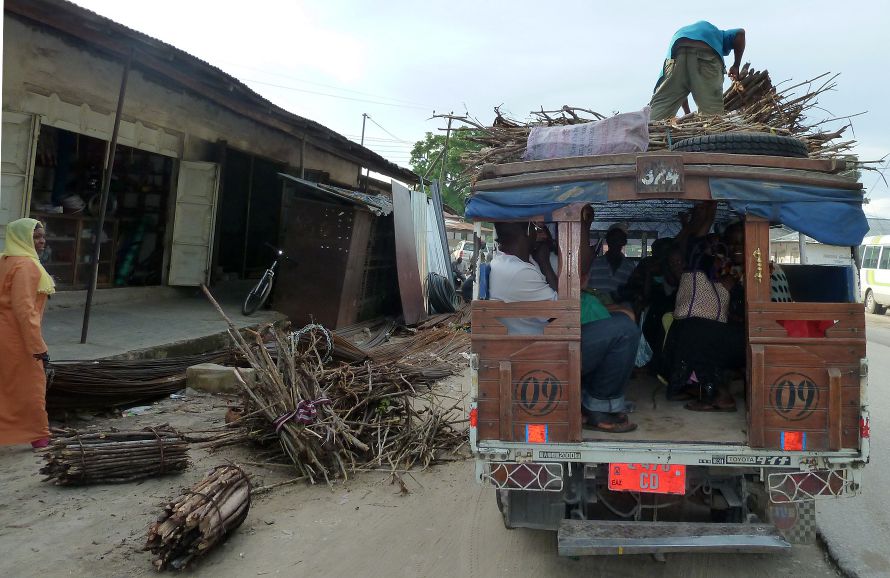 Now wait by the road for a Dala-Dala back to Stone Town. This time, sat in the back like everyone else. They had to chase 2 kids off the seat (down to floor) in order to squeeze us in. Still at each subsequent stop, people kept piling in, until I couldn't move a millimeter, the floor was also packed with people, 4 guys hanging on the back. Maybe totaled ~30 in this truck. Eventually, people started getting off. The boy who collects ticket (Tsh2000, kids less) climbed to the roof to toss down luggage. A surprising number of them carry bundles of firewood. A CLOSE encounter with the locals. Quite a few of these wear beautifully embroidered scarves, and speak excellent English.
Dinner at Silk Road Indian restaurant. Food is mediocre, over cooked and too salty. Nice decor, good service: chilled glass for beer, 2 straws in drinks, cold towel to clean hands before dinner and a bowl of water with lime to clean afterwards. A tray of cracker, celery sticks and carrot before meal, a bowl of mixed spices to clean palette in the end.
Day 27, Nov.20, Sunday. Overcast, warm.
5:3am breakfast: only a bun and a banana. 6am depart for the ferry terminal. Man and women in two separate boarding lines. 7am Kilimanjaro vessel, economy class upper deck. First class VIP lounge was too cold. Toilet lower deck, clean, no paper.
We were only given Tsh5000 for lunch in a big shopping mall. Clean, AC.
4:30pm reached the campground ran by Motel White Parrot in Korogwe. 6:30 dinner at its restaurant. Again, a green vegetable called Chinese, overcooked chicken, soup, rice, noddle, curry, a stew of banana and stomach. Uneventful.
Day 28, Nov.21, Monday. Cloudy.
 6am depart towards Arusha. Gianni had to stop the truck to look for his sunglasses. Very scenic all the way to Mombo. Morning mist hung in midst of mountains, rows of sisal in straight lines. Further north is a bit drier. Moshi seems very wealthy. Too cloudy to see Mt Kilimanjaro, maybe just a shape. Lots of sisal plantation. Arusha is bustling, lots of people and cars. We spent some time at Culture Heritage Center, a family run business. The building and ground was designed by its owner. Interior design by a Nairobi firm called Intuition Studio. Very nice. Merits at least an hour. Various styles and sizes of different art objects, 4 floors full, one spiral walk way and one regular set of stairs, so you can admire the entire collection without retrace your steps. Outside the main gallery are craft shops. One of them sells Tanzanite - a blue-violet gem stone. The owner, in a blue-violet shirt, kindly showed us different grade of stones, priced from $1000 to over a $1M (at $200/carat).
Arrived at ~3pm at Meserani Snake Park in the outskirt of Arusha. Many guinea fowls walk in the camping area, various snakes in glass cages, crocodile, 1 vulture, 1 lonely yellow baboon in cages. No hot water. Dinner at 7:45. Vernon made boboti using Mrs Ball's peach/apricot chutney, raisin, ground beef, onion. Then baked with egg + milk on top.
Repack for smaller game drive vehicles for the next 3 days.
Day 29, Nov 22. Tuesday. Overcast, rain.
 9am depart in two 7-seat open top Toyota trucks towards Serengeti. 10:30am, passed Lake Manyara. Photo stop and shopping stop. ~noon, it took a long time to register and pay at the gate of Ngorongoro Conservation Area. Monkeys in the parking area in front of the gate. The drive up to the rim is lush. Large trees with hanging moss. It rained. Box lunch near the rim of the crater. Marabou stork stalk our food. As we descended, the air turned drier, and vegetation became scarce.
 ~2.30pm, Maasai village tour. Maasai people are allowed to live inside the conservation area keeping traditional life style. There are many Maasai villages (or rather family compounds) along the road to Serengeti. Herds of goats or cattle. After collecting $10 each, a group of bejeweled men and women came out of the circular compound fenced in with wooden sticks, singing and jumping, and inviting us to jump with them. Their earlobes all have huge holes due to heavy earrings. Women wear burdensome flat necklaces of beads made of cow horn, seed, wood. Once in the compound, every two of us were assigned to one guy and was lead to sit in his tiny house made of acacia wood, grass, plastered with cow dung. They are so low, that you can not stand straight. Ours had two planks for bed, 2 shelves, full of smoke: a fire in center, despite the warm temperature. Our guy told us that he is in training to be the next chief, because his father is the chief. Unlike his father who has 40 wives, he has only 1 wife and 1 child. After asking us to ask questions and claimed that he wanted to make us happy and it makes him happy to answer our questions, he ushered us out to see the "market" before I could ask more than 1 question. The so-called market is just a stand next to his house. Necklaces, bracelets made by his wife who was standing next to the stand. Then we were lead to donate at the preschool just outside of the circle. As soon as the money is put into a jar, the school master cut short the song of the kids and we were escorted out to make room for the next 2 tourists. Apparently everyone of us were treated in similar fashion. Felt like a scam. Either all Maasai people are corrupt by money or tourism, or this particular village.
  Reached the Serengeti National Park boundary ~4pm. Just a sign in the seemingly endless desert-like flat land. About 20 minutes later, we encountered the grand migration troupe of wildebeest. The park gate is 10 minutes later in front of a butte, with services. From the hill top, we saw miles and miles full of wildebeest, endless like ants dotting the entire plain. The shear number is mind-boggling. There's one lone elephant, a few vultures surveying on top of a tree close by, and some zebras, gazelles, ostrich mixed with the wildebeest mass.
  Alister spotted a lion who was stalking some zebras. We waited for almost half an hour, but had to leave, because our ticket doesn't allow night time on the road. On the way to the camp (at least 50km away) saw 2 foxes, 2 lions on a tree, a hippo walking, 1 dik-dik.
 ~7pm, we reached one camping section in a very large camping area. Pre-set tents, bed sheet over mattress, and a pillow. 2 concrete buildings in our section, one for cooking, one for eating. Hundreds of moths circled the lights. Our cook made soup, beef stew, coleslaw, store-bought bread, sliced pineapple and mangle. 1 toilet stall, 2 sinks, cold shower.
Amazing stars! Hyena called all night.
Day 30, Nov 23. Wednesday. Overcast, rain.
 6am morning game drive. topi (half-cooked :), hartebeest, dik-dik, spotted hyena, bat-eared fox, giraffe, 1 male + 1 female lion, a mother and child hippo walking into a pond full of hippos, another male lion with beautiful mane looking pretty on top of an exposed rock and a few females hiding in the shade around the big rock. Thompson gazelle is very pretty. The antelopes tremble to get rid off flies. Birds: white-headed buffalo weaver, lappet-faced vulture, tawny eagle, white-belly bustard, a martial eagle, black-winged stilt, blacksmith plover, crowned plover, little bee-eater, long-tailed shrike, Egyptian geese, sparrow weaver, blue capped cordon-bleu. Many masked weaver weaving their nests in the campground. The prettiest of these: Fischer's lovebird and lilac-breasted roller.
 This was raining season. Very green, even have some small flowers: blue ink flower (pink), tiny red or white hibiscus.
 ~10am, return to camp for breakfast and waiting for the heat to dissipated a bit. Depart again ~noon back towards the gate. Clouds moved in. Saw 1 dung beetle by the truck, giraffe close by, more zebras, a couple of beautiful crowned cranes, a pride of 9 lions, 5 of those going down a sausage tree one by one.
  . Another lion family of 6 with 1 baby. One leopard up and down a sausage tree, but too far to take a decent photo. Yet another lion couple on a rock. 2 elephants. As we approached the park gate, less and less trees, lower grass, more savannah like, very flat. Eventually desert like, few brown grass. At the park gate, same migration troupe. As we climbed back up Ngorongoro Crater rim, more and more trees, wetter and greener. Shower: heavy but short.
Camped at the rim. Limited hot water. By the time I took the shower (3rd in line), it was barely warm. Dinner at 7. We sat around camp fire to keep warm. For some reason, an animated debate of how men use squat toilet lasted over an hour, with demonstrations from Tina + Alex and Mike + Alister.
Day 31. Nov. 24. Thursday. Overcast.
5:30am breakfast. Collected tip fro the cooks and tent helper. $10 was recommended.
 Descended on a one way paved road to Ngorongoro Crater. Sacred ibis, crowned crane, kori bustard, 1 eland too far for photos. Two lion couples by the road, 2 rhinos, then 3 lions. The highlight is at ~9:30am, 2 lions eating a wildebeest while a group of jackal (both golden and black-backed) trying to steal a few pieces.
 We were rushed out of the crater. Rained. A couple of sections of the road inundated. One piece of concrete pavement was broken. Villages standing in water. A few overturned vehicles. People jumped on the back of our truck to cross the flood. Stopped at the picnic area in the Maasai curio shop next to the Manyara View Lodge for lunch. Same boxed lunch. Filled an evaluation form for the Serengeti excursion. Collected tips for the guides. Suggested $20.
Back to Snake Park campground ~3pm. Did laundry while the sun was still out. A few in my group went to the Tanzanite shop and Arusha town, didn't come back until 6:30 in pouring rain. Dinner at 7pm in the restaurant next to the bar: overcooked pork chop + beef sausage and chicken. Over-boiled veggie, coleslaw, tomato salad, potato. Plenty and overcooked. Most people hung out in the bar to late at night (last evening of the tour). I learned two knots from Don.
Notes
Subscribe to:
Posts (Atom)