Thursday, June 29, 2006

Two weeks in Peru. 6/26 - last day. Lima, the capital.
Flew to Lima 8:10 - 9:35am. Rented a locker (s/28), shared a taxi (s/36.5) to Lima Centro with Amy and Tom from Inca Trail.
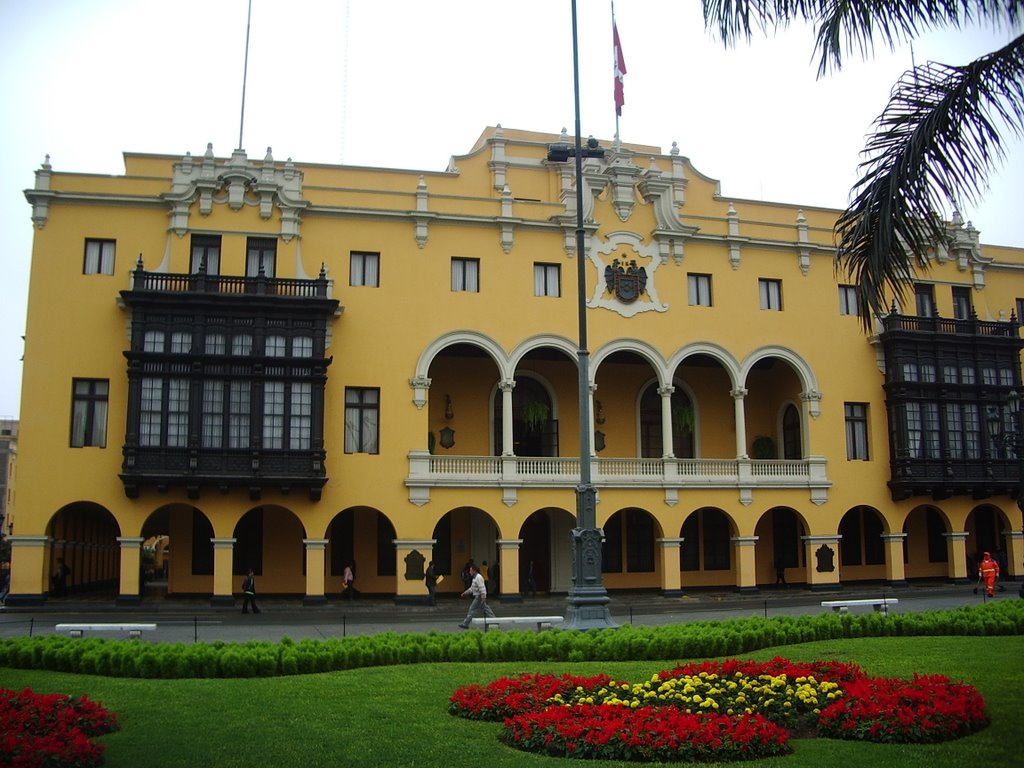
It was ugly all the way in. However, Plaza Mayor is in full colonial glory, flanked by the cathedral to the east, Palacio de Gobierno to the north (a replica of Pizarro's residence once stood here), and Palacio Municipal (city hall) to the west. Guard change M-Sat 11:45-12:15 inside the gate of presidential palace. To visit, make a reservation at least one day ahead at the tourism office 201 Jr. de la Union, 311-3908 or www.presidencia.gob.pe.
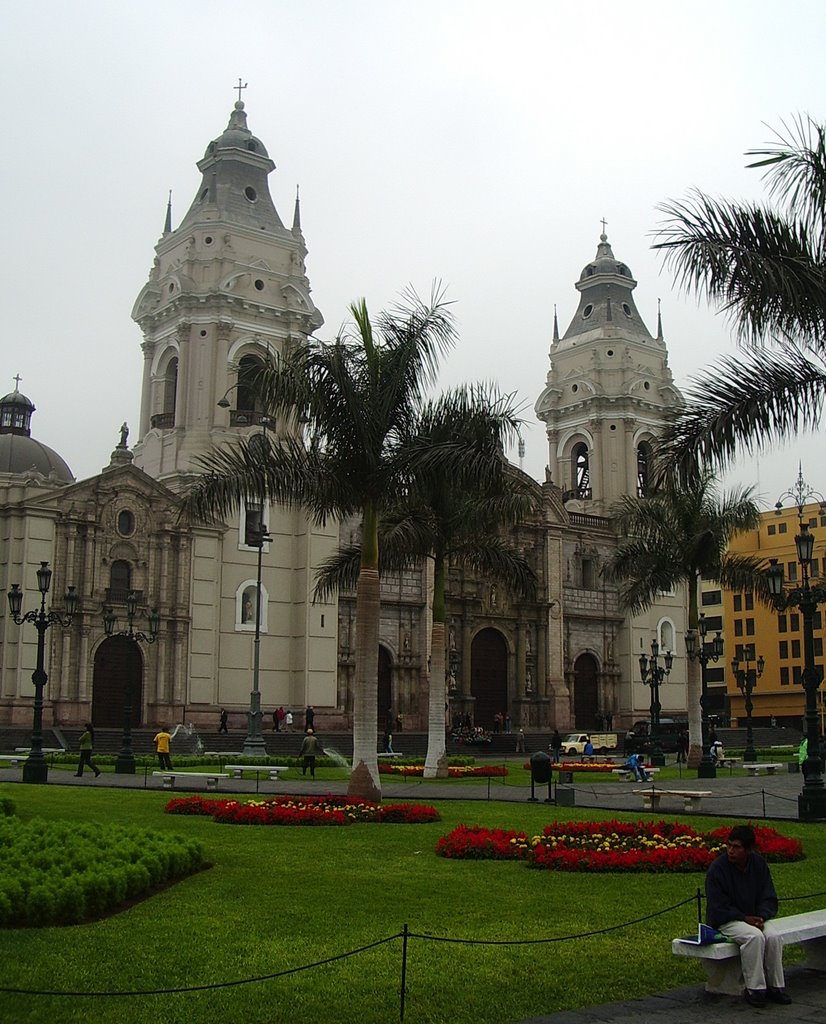
The only thing survived the 1746 earthquake is the small bronze fountain (1651 by Pedro de Noguera) at the center of the plaza.
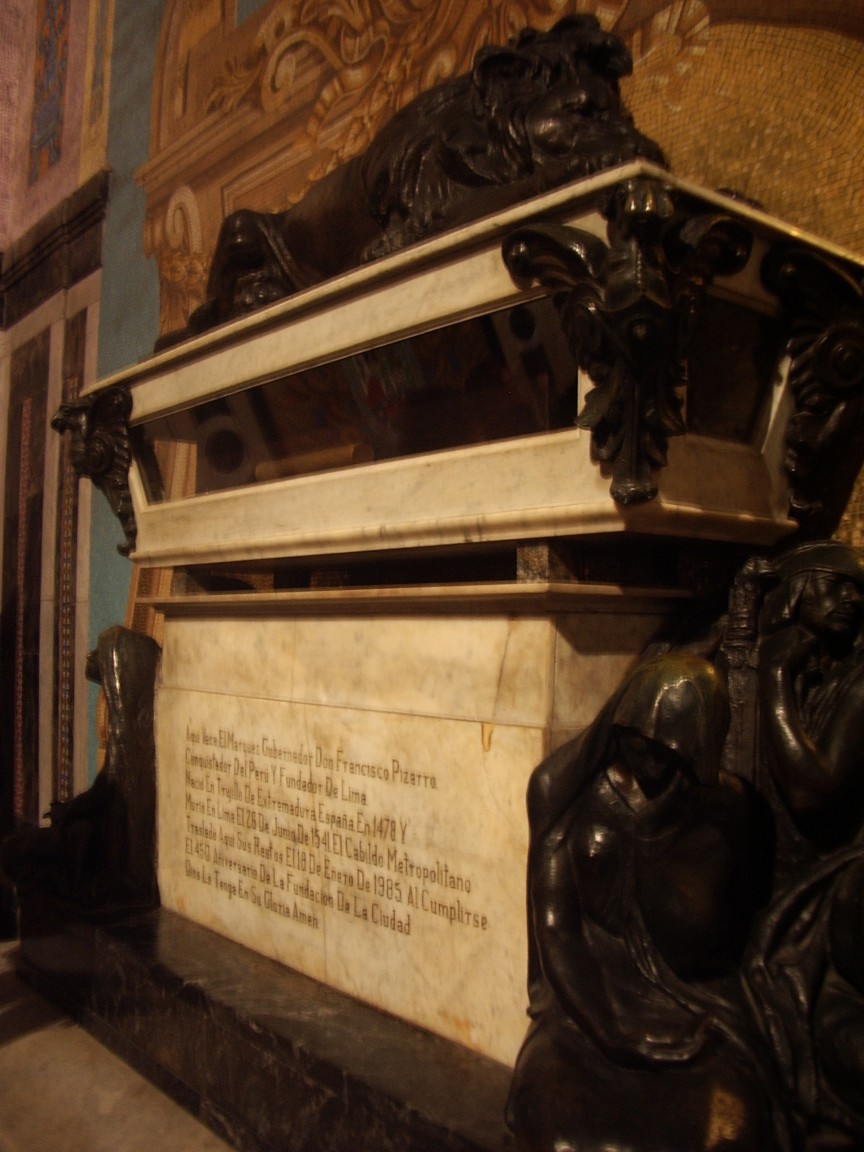
Catedral de Lima (s/20, free English guided tour, however, after trying about five guides, I still didn't get half of what they tried to tell.) claims to contain the remains of Francisco Pizarro, who died in Lima in 1541. In the center is 40-some-seat wooden choir ensemble carved by Pedro de Noguera. Below, all archbishops of Lima repose in the small crypt. It also houses the very first Peruvian university diploma. The declaration of independence was signed in this room in 1821.
A much more interesting church is Convento de San Francisco (s/5, free Spanish guide). Some priceless treasures here: a 2-story Franciscan library with over 25000 rare books, a bamboo dome able to withstand any quake, a painting of last supper with Peruvian food (guinea pig, potatoes, ...), and the beautiful cloister (now half as what used to be) inlaid with Sevillian tiles and murals depicting the life of St. Francis of Assisi. An eerie highlight is the catacombs, narrow underground passages containing skulls and bones of over 25000 bodies, neatly arranged for photos. Before the city cemetery was opened in 1808, corpses were dumped under this church. Now only Franciscan brothers can be interred here.
There're many other churches to visit in Lima Central. A hectic pedestrian street La Union connects Plaza Mayor and the grassy Plaza San Martin.

Lima is big on cerviche, a traditional dish of raw white fish marinated in lemon and tossed with onion, or any seafood or fish. Prices are higher here than Cusco. Equally salty. I didn't find any chicha here. Lots of stalls selling fresh squeezed orange juice.

Miraflores, a well-to-do suburb bordering Pacific ocean. As the sun sets down, Parque Kennedy comes to life. A dozen venders set up their second-hand stalls. Even kids came out to play under street lights. I enjoyed a box of sweet concoction of hot porridge and purple fruit syrup, topped with shreds of coconut. Also bought a bottle of pisco sour in the crowded vicinity.

Taxi to airport (s/25) to catch the midnight flight out of Lima. Hefty international airport tax ($30). Back to Seattle around 10:30 the next morning, sound and content, yet tired.

2006.6.25 - Two weeks in Cusco, Peru - day 14.

Huchuy Cusco (little cusco) is high up the hill (4.8km one way, steep) west of the village of Lamay (2930m, s/2.5 bus from Cusco, 11km north of Pisac), across the bridge over the Urubamba River. It took me about 3 hrs up, and 1 hr down. The entire hike was unshaded: dry dirt path lined with bushes barely half as my height. I was dead tired going up. At km 2.0, had to take a nap in the only resting place along the trail: a straw hut. The scotching sun turned to hail while I was dozing off. It later turned to rain, and then quited down. Luckily the sun only came out again when we began our descent, lost all its earlier force. At km 4.0, the slope becomes gentler, and you loose the sight of the bottom of the valley, and gain a glimpse of the adobe+stone walls of the ruin. It's thought to be the hideaway of Inca Wiracocha during the Chanca invasion. There's a community of 128 people, farming in this idyllic land, high above the world, overlooking snow capped mountains. We met a girl who was herding some sheep on the slopes behind the ruins. The three dogs of hers fought for the bread crumbs in my hand.

2006.6.24. Two weeks in Cusco, Peru

6/24, Saturday, Inti Raymi, the sun festival. This site offers detailed descriptions and nice photos.

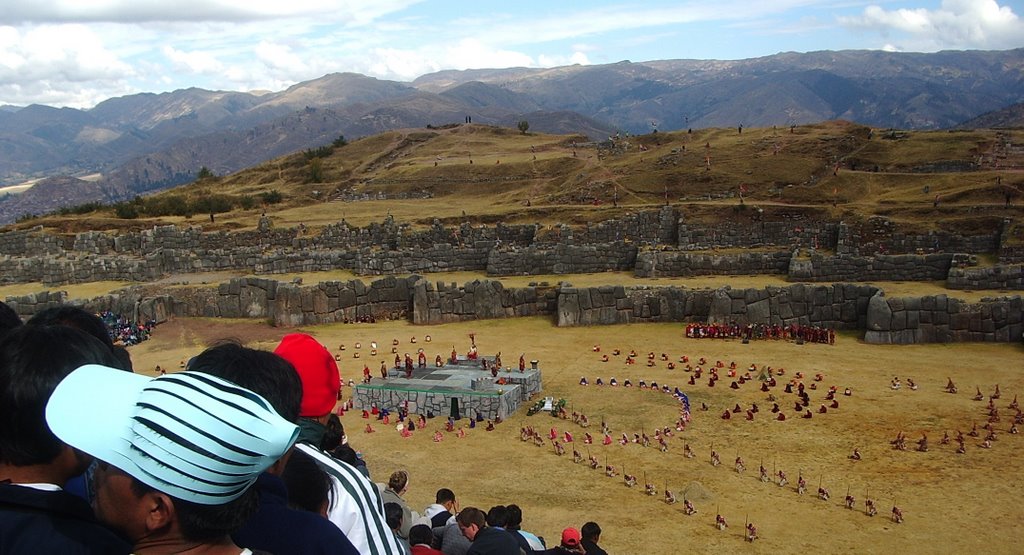
All started at ~9:20am at the grassy square of Qoricancha. It took half an hour for all groups of performers to appear, men first, then the chosen women. A high priest gave a speech (all in Quechua) from the balcony of Qoricancha casting some plants down to the spectators. Finally the Inca came out, calling for God. At ~10am, the royal followers walked along Pampa del Castillo and Loreto, to Plaza de Armas, carrying Inca and his queen in elevated seats. From there, the whole assembly marched up to Sacsayhuamán.

We lunched before joining the hordes at Sacsayhuamán. Needed some food in order to hike up the rather steep 2km slope. By the time we arrived (~2pm), it was difficult to find a spot on the surrounding hills. (For $80, you can buy a seat from a central office ahead of time. Maybe the most profitable show on earth!) Many people picnicked here. Women selling popcorns and popsicles. Looked like a family outing day. Some of them didn't seem to care about the spectacle, settling comfortably in places completely barred from the view of the stage.
Pyres of branches and dry grass were lit, generating lots of smoke. A llama was selected and sacrificed. It started hailing before llama was killed for a short while, but didn't stall the performance. The high priest took out the entrails trying to read some future out of it. He threw a piece into the fire, and then offered the bleeding heart to the Inca, and the Inca ate a piece of it, while giving a long discourse. With the announcement of the beginning of a new year, more dances followed, until about 3pm. To me, it was equally fun to watch all the coming and going of spectators (sometimes in perilous locations), the noise, the comments, and business transactions (tossing popcorns and coins).

Finally everyone left, leaving the entire ground covered with litter. Before heading down to town, we walked over to the silly Cristo Blanco, a Brazilian present.
Two weeks in Cusco, Peru 6/23 - day 12. Fair at Huancaro (s/3).
Dumped laundry, moved hotel to Colonial Palace on the same street ($35), which I booked earlier. It was not a good move: noisy (a church group did a long sermon in the early evening that day), thin curtains. Reliable hot water.

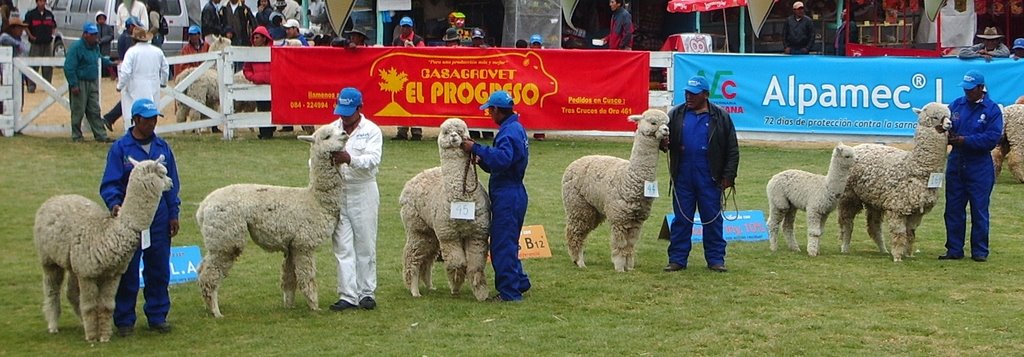
Went to the fair at the Huancaro suburb. Apparently this had been going on for a few days already. Pet zoos / vendors for alpacas, llamas, cows, guinea pigs (s/20 live and cute) and rabbits. Endless stalls selling various produces (I bought some honey). Government agriculture display and even an environment awareness booth. And of course, food and drink. We watched one of the alpaca beauty contests, when it rained. Ate roasted pig (lechon) and guinea pig (cuy, not much meat, tender, but skin was a bit tough. Same salty spice. s/20.) I think I prefer these rodents alive.

In the afternoon, we visited the Cathedral (s/16, 1559-1669) . Nice carved choir, some paintings by the Cusco School, many dull chapels. The only thing interesting is a painting of Last Supper, where Jesus and his disciples feast on a guinea pig. Museo Inka (s/10), housed in the 17th century Palacio del Almirante, is well organized. Excellent guide. A hour-long history lesson of the pre-Inca Chimu, Mochica, Nasca, Pucara, Tiahuanaco and Wari people, and their influences to Inca, the Spanish conquest. There is a 3000 year-old funeral cloth, still in wonderful shape and vivid in color. A model of Queshwachaka bridge over Apurimac River, entirely made out of straws. Our guide emphasized the organization of Inca and their agriculture skills. According to her, these are the two crucial merits that enabled Inca to govern and expand, welcomed by various local tribes.

Went shopping at the Centro Artesanal Cusco off Ave. El Sol bordering Pachacutec. Bought more alpaca sweaters and scarves. More parades, well into the night. Ave El Sol was full of people and food stands. Drank a glass of hot soy-based sweet concoction. I liked it.
Two weeks in Cusco, Peru. 6/22 - day 11. Chinchero - Moray - Las Salineras.
Chinchero (bus s/2, 45 min. elev. 3762m) was once Inca Tupac Yupanqui's country resort. Inca terraces, still in use by the local farmers. The small Spanish church (closes noon-1) is complete covered by colorful murals.

The tiny village of Maras is 4km west of the main road between Urubamba (~10 min) and Chinchero (~20 min). Beautiful scenery: snow peaks of Vilcanota Mountains, planted rolling hills, kids walking home from school (5km?) along the long dirt road, together with donkeys full of loads.
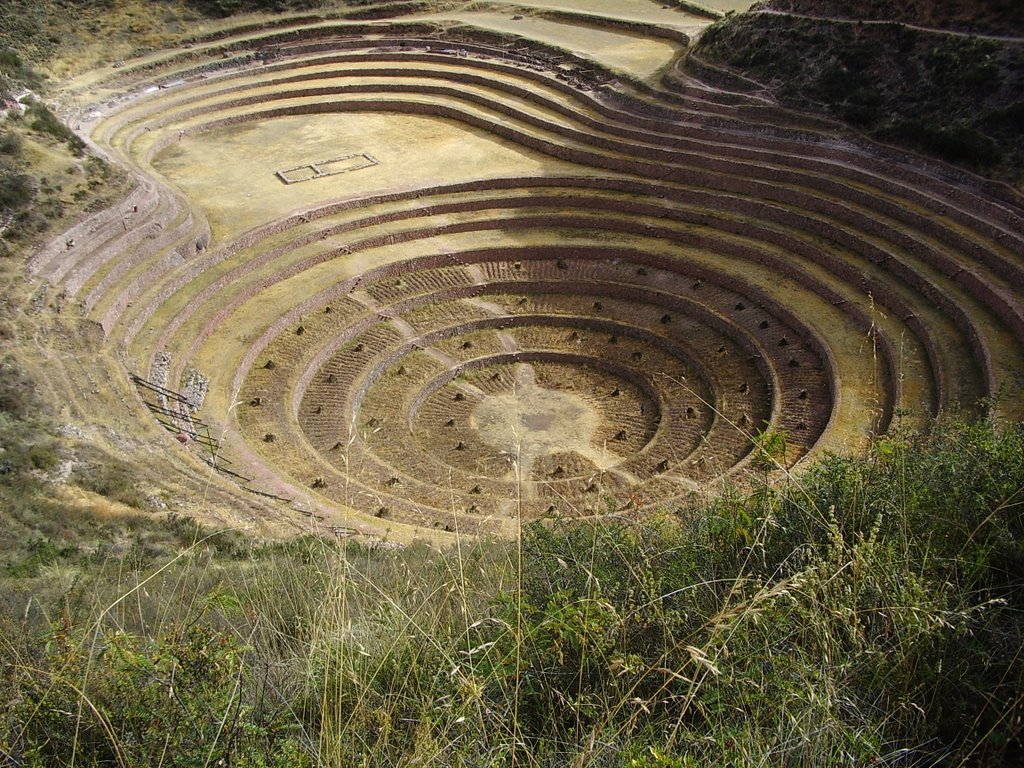
Hitched a taxi (s/55, probably was ripped off) to visit Moray (s/5, 8km NW.) and Las Salineras (s/5, 7km N.). Moray consists of three sets of concentric terraces (still farmed with potatoes, oats, and ...), in the natural depressions of the earth. Believed to be an agricultural experiment lab even before the Incas. Temperatures were said to be up to 15 degrees higher in the lower levels. However, I couldn't feel that.
Apparently, local potatoes tasted salty. There's an underground stream so saline that white crystals form on the rocks alongside the water. The water is also quite warm. The pre-Inca salt pans, 4000 pozas (shallow pools), dug into the hillside, still produce salt today.

A quick stroll and meal in the busy yet unimpressive town of Urubamba (elev. 2871m) in the valley. Caught the bus back to Cusco (last one leaves at 7pm). I must have eaten something bad, had a terrible fit in the bowel an hour later on the bus.