King and I, 9/27/2005
The night I returned from China, I went to see this musical at the 5th Ave Theater despite of fatigue.
Very similar to the original movie. Well done, but nothing new.
Tuesday, September 27, 2005
China part 6 of 6: Emei Mountain 峨眉山 and Leshan Buddha 乐山大佛 (9/21-22)
This can be a trip of Buddhism education. 峨眉山 is one of the four major pilgrimage destinations, dedicated to Samantabhadra 普贤菩萨, the Buddha of truth and peace, (together with Putuo Mountain 普陀山 in Zhejiang 浙江 province for Avalokitesvara 观音菩萨, the Buddha of compassion; Wutai Mountain 五台山 in Shanxi 山西 for Manjusri 文殊菩萨, the Buddha of wisdom; Jiuhua Mountain 九华山 in Anhui 安徽 for Ksitigarbha 地藏菩萨, the Buddha of protection).
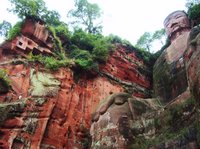 The city of Leshan 乐山 is about 70Km south of Chengdu 成都. The Grand Buddha was sculptured (713-803 AD) out of the cliff 凌云山 at the confluence of three Rivers: 岷江, 大渡河, 青衣江, in order to protect the boats and their passengers. At 71m tall, with two 7m long ears and 8m wide feet, it's considered as the world's largest. Originally it had 13 stories of wooden worshiping temple. Long disappeared. The ancient walkway still exists on both sides of him (one way traffic now). Thousands of people queue up in order to walk down and admire his entire image. The wait can be 30 min - 1 hour. From the gate (¥70, half for students and seniors) to the top of the hill is quite pleasant (if not crowded). At the top, before and after your queue for the Buddha, you can pause at many tea houses and old pavilions. Our guide spent almost 2 hours on the procedures of the blessing ceremonies 开光 being taken place at Emei Mountain 峨眉山 (once every few years), and encouraged everyone to attend and purchase proper items to be blessed.
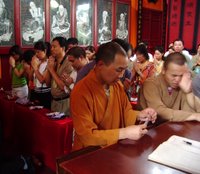 The next day, 峨眉山 (¥120, half for students and seniors). ¥60 bus goes from the gate 报国寺 to the cable car terminal. After the lift ¥40, we reached the main worship spot, Wannian Temple 万年寺, halfway up the slope. Many of our fellow tourist applied for blessing here. It was a "mass production". Every session took around 10 minutes, about 30 people at a time. The monk walked by everyone chanting, sprinkled water at the object to be blessed and the head of the believers. At the side, a row of monks kept order, counted donations (¥50 a piece) and wrote down the names of the doners.
  万年寺's main temple is brick, no supporting columns. It houses a big bronze statue of Samantabhadra 普贤菩萨 sitting on an 6-toothed elephant. Due to its large scale, scholars are still debating on how the statue was made and hauled up here.
We didn't go for the summit, as the temple up there was in remodeling. On our way down from 万年寺, a group of monkeys came and tried to steal food from the tourists. But when we went to the monkey view area, not a single one was to be found. However, it was the most enjoyable walk in these two days. Very scenic all the way accompanied by a creek.
We joined another tour group for this trip. This time it was a mistake. The tour guides constantly pushed products: 3 shopping stops on the first day: a factory showroom of crystal, a jade store associated with the provincial tourism bureau that sells Buddha pendants, and a foot massage parlor that sells high-priced Tibetan medicine. Each was filled with people, parking lots full of tour buses. The 2nd day, a tea shop and traditional medicine stalls.
This can be a trip of Buddhism education. 峨眉山 is one of the four major pilgrimage destinations, dedicated to Samantabhadra 普贤菩萨, the Buddha of truth and peace, (together with Putuo Mountain 普陀山 in Zhejiang 浙江 province for Avalokitesvara 观音菩萨, the Buddha of compassion; Wutai Mountain 五台山 in Shanxi 山西 for Manjusri 文殊菩萨, the Buddha of wisdom; Jiuhua Mountain 九华山 in Anhui 安徽 for Ksitigarbha 地藏菩萨, the Buddha of protection).
 The city of Leshan 乐山 is about 70Km south of Chengdu 成都. The Grand Buddha was sculptured (713-803 AD) out of the cliff 凌云山 at the confluence of three Rivers: 岷江, 大渡河, 青衣江, in order to protect the boats and their passengers. At 71m tall, with two 7m long ears and 8m wide feet, it's considered as the world's largest. Originally it had 13 stories of wooden worshiping temple. Long disappeared. The ancient walkway still exists on both sides of him (one way traffic now). Thousands of people queue up in order to walk down and admire his entire image. The wait can be 30 min - 1 hour. From the gate (¥70, half for students and seniors) to the top of the hill is quite pleasant (if not crowded). At the top, before and after your queue for the Buddha, you can pause at many tea houses and old pavilions. Our guide spent almost 2 hours on the procedures of the blessing ceremonies 开光 being taken place at Emei Mountain 峨眉山 (once every few years), and encouraged everyone to attend and purchase proper items to be blessed.
 The next day, 峨眉山 (¥120, half for students and seniors). ¥60 bus goes from the gate 报国寺 to the cable car terminal. After the lift ¥40, we reached the main worship spot, Wannian Temple 万年寺, halfway up the slope. Many of our fellow tourist applied for blessing here. It was a "mass production". Every session took around 10 minutes, about 30 people at a time. The monk walked by everyone chanting, sprinkled water at the object to be blessed and the head of the believers. At the side, a row of monks kept order, counted donations (¥50 a piece) and wrote down the names of the doners.
  万年寺's main temple is brick, no supporting columns. It houses a big bronze statue of Samantabhadra 普贤菩萨 sitting on an 6-toothed elephant. Due to its large scale, scholars are still debating on how the statue was made and hauled up here.
We didn't go for the summit, as the temple up there was in remodeling. On our way down from 万年寺, a group of monkeys came and tried to steal food from the tourists. But when we went to the monkey view area, not a single one was to be found. However, it was the most enjoyable walk in these two days. Very scenic all the way accompanied by a creek.
We joined another tour group for this trip. This time it was a mistake. The tour guides constantly pushed products: 3 shopping stops on the first day: a factory showroom of crystal, a jade store associated with the provincial tourism bureau that sells Buddha pendants, and a foot massage parlor that sells high-priced Tibetan medicine. Each was filled with people, parking lots full of tour buses. The 2nd day, a tea shop and traditional medicine stalls.


2005.9.18-20 China part 5 of 6: The Four Girls Mountain 四姑娘山
 This scenic area is located near the town Rilong 日隆乡 (3160m), roughly 6 hours' drive west of Chengdu 成都 (~230Km). Named after the four contiguous peaks of 5672m, 6250m, 5664m, 5700m, the developer of this area tries to branded it as the east Alps.
 There're three valleys: 双桥沟 (double bridges), 长坪沟 (long meadow), 海子沟 (lakes). Elevation a little over 3000m. Air is crisply clean. Deep blue sky that you would never see in 成都. The best season should be early-mid summer. We were too late for the flowers.
 We spent the first afternoon at 双桥沟 (¥80 + narrated eco bus ¥80). There're five stops. Meadows, icy cold river, high peaks. That night, after dinner, the guide made us attend a silly party, where they served two whole lamb over the open fire. The meat was tough. Three Tibetan girls came, sang and danced, poured us barley wine 青稞酒 and butter tea 酥油茶, and we the tourists participated, also sang and danced and did silly games. It was fun. I laughed so hard that my tummy ached.
 The second day was entirely spent in 长坪沟 (¥70 + ¥40 small van). The paved road is fairly short. About 5 minutes into the gate is where you can hire a horse and its owner, or start hiking. My father paid ¥150 for a horse, but almost fell off after an hour or so. He ended up walking back.
  The beginning 3Km is a pleasant board walk and ends at a river bend 枯树滩. Forest with open views. Many tiny waterfalls hang on the steep slope on other side of the valley. From this point on only muddy and rocky horse trail, littered with horse poop. I insisted on walking all the way to the end (about 3 hours one way, 9Km?), thus had a piece of solitude (a rare thing in China) most of the time.
  The trail ends at a large meadow surrounded by mountains (two glaciers?). There was a large herd of Tibetan bison, and so the countless piles of bison excrement (at least one per m^2). This is at the backside of the 4th Mountain which you can see at the entrance. Along this trail, I encountered two groups of Americans. They were here camping and hiking. Out of about 70-80 Chinese tourists that day, only 3 walked.
The drive is also quite scenic. Valley and trees along Balang Creek 巴朗. Large stretches of meadow cover the slope of Balang Mountain (巴朗 4487m), dotted with Tibetan bisons. These animals live a happy life. The owner comes around only once a month to feed them some salt and occasionally medicine.
On the way home, we stopped at the Wolong Giant Panda Reserve 卧龙级国家级自然保护区. You don't get to see wild pandas here. It's a research center, quite small too. Do check out the nursery: the babies are adorable.
The trail ends at a large meadow surrounded by mountains (two glaciers?). There was a large herd of Tibetan bison, and so the countless piles of bison excrement (at least one per m^2). This is at the backside of the 4th Mountain which you can see at the entrance. Along this trail, I encountered two groups of Americans. They were here camping and hiking. Out of about 70-80 Chinese tourists that day, only 3 walked.
The drive is also quite scenic. Valley and trees along Balang Creek 巴朗. Large stretches of meadow cover the slope of Balang Mountain (巴朗 4487m), dotted with Tibetan bisons. These animals live a happy life. The owner comes around only once a month to feed them some salt and occasionally medicine.
On the way home, we stopped at the Wolong Giant Panda Reserve 卧龙级国家级自然保护区. You don't get to see wild pandas here. It's a research center, quite small too. Do check out the nursery: the babies are adorable. 
 Note, it's possible to come here by bus (~¥40) from Chengdu 成都, direction Xiaojin 小金. All entrance fees are half off for students and seniors. This is not very regulated. Tour guides sometimes negotiate the fees (to pocket the difference), and you get in without the printed tickets.
China part 4 of 6: Dujiangyan 都江堰 and Mt Qincheng 青城山 (9/17)
The city of 都江堰 is about an hour of bus ride (¥15.5, 56 Km) from 茶店子 transit center. Bus leaves as soon as it is filled, and it fills up quickly.
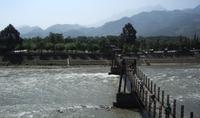 都江堰, on the west edge of the city, is an irrigation system built 2200 years ago (before gunpowder was invented) and still in use. No dam was erected. The clever design of 李冰 is still studied by every hydraulic engineers-to-be in China.
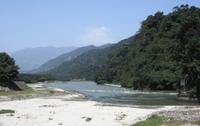 岷江 River is diverted here into two branches. Only one goes into the city for irrigation. By using different depth and width, this one never overflows nor dries out, while the outer river holds the majority of the volume when flooding, and bares its bottom when in drought. Another example, this picture shows 飞沙堰, a 200m buffer zone right at the water direction. On the side of it is the true water outlet at an angle. This effectively keeps the sediment of the inner river from flowing into the city.
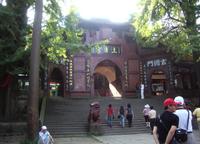 青城山 is only about 15 Km away. A pleasant place to visit in hot summer (much cooler here). Lots of buses (¥4.5) go from 都江堰 city's transit center to the entrance gate of the mountain. ¥60 (senior 50%). It's possible to take a chair lift (¥35, real SLOW) to get up halfway. In order to take it, you'll have to first take a large flat boat to cross a tiny lake (¥5, crossing time < 5 minutes, waiting time 5-15 mins until the boat is filled). Then it's only 1-2 Km's walk up to ShangQing Temple 上清宫 (built from the 300s. The current three characters were written by 蒋介石 Chiang Kai-shek). Here, one can continue up to 老君庙, or walk down. The walk is a lot more pleasant than the chair lift. Narrow. You can buy a cucumber from the peasants along the way or light a joss stick at 天师洞, where 张天师 (Taoism's founder) studied. It's in a large natural cave. In the old days, people came here to seek solitude or study Taoism. Now, you walk among vendors and flirting students (it was a Sunday), only the music that were softly playing in the speakers (hidden in the trees) still convey a little bit of the serenity.
The city of 都江堰 is about an hour of bus ride (¥15.5, 56 Km) from 茶店子 transit center. Bus leaves as soon as it is filled, and it fills up quickly.
 都江堰, on the west edge of the city, is an irrigation system built 2200 years ago (before gunpowder was invented) and still in use. No dam was erected. The clever design of 李冰 is still studied by every hydraulic engineers-to-be in China.
 岷江 River is diverted here into two branches. Only one goes into the city for irrigation. By using different depth and width, this one never overflows nor dries out, while the outer river holds the majority of the volume when flooding, and bares its bottom when in drought. Another example, this picture shows 飞沙堰, a 200m buffer zone right at the water direction. On the side of it is the true water outlet at an angle. This effectively keeps the sediment of the inner river from flowing into the city.
 青城山 is only about 15 Km away. A pleasant place to visit in hot summer (much cooler here). Lots of buses (¥4.5) go from 都江堰 city's transit center to the entrance gate of the mountain. ¥60 (senior 50%). It's possible to take a chair lift (¥35, real SLOW) to get up halfway. In order to take it, you'll have to first take a large flat boat to cross a tiny lake (¥5, crossing time < 5 minutes, waiting time 5-15 mins until the boat is filled). Then it's only 1-2 Km's walk up to ShangQing Temple 上清宫 (built from the 300s. The current three characters were written by 蒋介石 Chiang Kai-shek). Here, one can continue up to 老君庙, or walk down. The walk is a lot more pleasant than the chair lift. Narrow. You can buy a cucumber from the peasants along the way or light a joss stick at 天师洞, where 张天师 (Taoism's founder) studied. It's in a large natural cave. In the old days, people came here to seek solitude or study Taoism. Now, you walk among vendors and flirting students (it was a Sunday), only the music that were softly playing in the speakers (hidden in the trees) still convey a little bit of the serenity.
China part 3 of 6: Jiuzhai 九寨沟 and Huanglong 黄龙: Karst geology. (9/13-16)
The small town Chuan-Zhu-Si 川主寺 has a new airport, about 45 min drive to 黄龙, and 90 min to 九寨沟. Every day, more than a dozen Boeing 757's fly in and then out. The flight to 成都 is only 40 minutes. However, on both directions, our flights were delayed by 3 hours. This is pretty common, not only because the bad planning of the airline dispatchers, mainly due to the weather. Altitude at 3446 m, amidst the mountain range, short runways, making the landing next to impossible in cloudy days. When we left at 11:30pm on 9/16, there were still hundreds of passengers stranded in the airport.
A cheaper alternative is bus (~¥150 instead of ¥770 each way), which follows 400 Km of mountain roads along the Min Jiang 岷江 River. 8-9 hours if everything goes smoothly. Landslide happens often, and you can be stuck for hours (as was my father last year).

We arrived at 九寨沟 at 5pm, even though we left our hotel in Chengdu just past 9am: a whole day affair to get here. Strolled to the park gate and back, bought a bottle of Tibetan barley wine 青稞扎酒, and some pancakes made of the same barley flour. We stayed at 九通 hotel (recommended by most online users) for 3 nights. Rooms are barely acceptable (¥160, I think we overpaid), but convenient: 1.5Km from the gate (one of the closest), and it shares a parking lot with the long distance bus company. It has a very nice indoor courtyard.
There're buses leaving for 黄龙 every morning at 7:10 and 8:00 (¥37). The bus has a layover of 4.5 hrs. It's possible to take the same bus back (¥40) or to get off at 川主寺 (¥20), so you can leave your bags on board.
 9/14, we arrived at Jiuzhai 九寨沟 ticket office at 6:30am. Combination ticket of ¥220 admission (students and senior ¥170) + ¥90 bus (no outside vehicles allowed in the park). We requested to come again the next day, and had our pictures printed on the tickets.
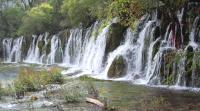
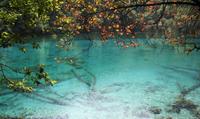
九寨沟 is THE place to see water. Super clear, blue-green. Quiet like a mirror or roaring as in the three major waterfalls.
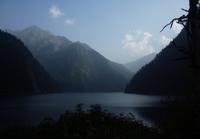 Park roads are in the form of a Y. One end is Long Lake 长海(the biggest in the park). Come here after 4pm, when everyone is gone. Otherwise, your toes may be stepped on -- yes, that many people. From here, walk down to 五彩池 5-color Pond. It's tiny, but gorgeous. The other end of the Y reaches undeveloped old growth forest. Very similar to the forest in Seattle area. Must have different species.
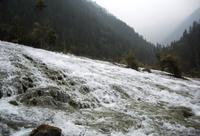 At the lower end of this branch is the beautiful pea-cock shaped 五花海 5-flower Lake (brightly colored); Pearl Shoal Falls 珍珠滩瀑布 (you can walk on the top of the falls where water jumps and glistens); and the peaceful Mirror Lake 镜海.
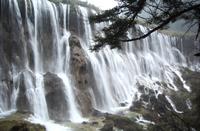 The two branches of Y connect at 诺日朗 tourist center, where you can transfer to the bus for another destination. Nothing to see in the center. Even though you can see 诺日朗瀑布 Ruorilong Falls from the bus, it's much better when you come closer.
 At the trunk of the Y, the road follows the water course: many cascades, lakes. My favorite is Reed Lake 芦苇海: in between the stops, hardly anyone walk by. There's a blue strip winding in the reeds.
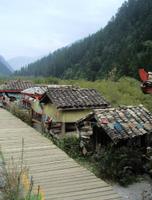 九寨沟 literally means "valley of nine villages", now three 藏 (a branch of the Tibetan) villages still exit in the park. These people are Buddhist. You can find many water mills used to turn the scripture cylinders. Colorful banners printed with words from the Buddhas, stringed together, fly high in air. It is said that every time a banner or a cylinder moves, a prayer is said.
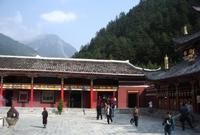 A formal temple is close to the park entrance: 扎如寺. Quite busy. They gave quick introduction and say prayers for the tourists in exchange for money. The large flat surface of the cliff in front of this temple is claimed to have segments resemble 12 zodiac animals -- all quite bogus.
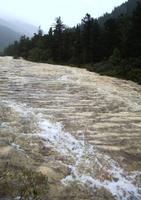 9/16, HuangLong 黄龙. We took the first bus and arrived around 10:30 am, about 0.5-1 hour ahead tour buses. It was foggy all the way, and before we arrived, it started raining.
黄龙 (¥200, students and seniors ¥150) is world's largest continuous open-air travertine formation. Grand, impressive, and colorful. Miles long golden calcium bicarbonate slope, amidst green mountain range. If it's clear, it's possible to see the snowy peak of Xuebaoding 雪宝顶 (5588m).
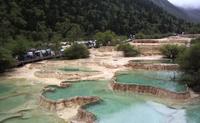 Algae and other aquatic plants' photosynthesis promotes the color and formation of the travertine ponds. These natural terraces of color are fascinating. Relentless rain and high altitude (from 3100m at the entrance to 3600m at the temple) cannot deter tourists' enthusiasm.
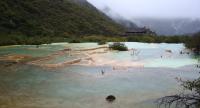 After 2.5 hr's walk on the gentle slope (~4Km), many photo shots and two stopovers for oxygen for my father (free, ¥1 breathing tube. I tried once, didn't feel any difference.), we reached the Taoist temple. The largest group of travertine ponds. Magnificent in all direction.
By the time we exited, the sun came out! On the gravel road back, while it zigzagged towards the mountain pass of over 4000m, we drank the mountain scenery that we missed on the way in: interesting rock formations, high snowy peaks briefly including 雪宝顶, some leftover snow on the grass.
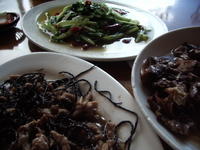 We arrived at 川主寺 around 5pm. Bought some yak meat, had supper (some interesting dishes: local wild mushrooms, and walnut flower?).
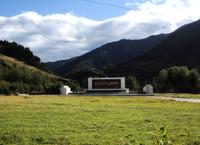 A memorial of Red Army's Long March 红军长征 was erected here in 1990. Between May and August 1936, the Red Army marched across the neighboring mountains and ravines, escaped the pursuit of the Nationalist. Even though a significant part of the troop was lost, the Communist managed to survive and kept its army, eventually (after over 10 years) kicked the Nationalist out of the mainland. Mao was also elected the head during the march.

The small town Chuan-Zhu-Si 川主寺 has a new airport, about 45 min drive to 黄龙, and 90 min to 九寨沟. Every day, more than a dozen Boeing 757's fly in and then out. The flight to 成都 is only 40 minutes. However, on both directions, our flights were delayed by 3 hours. This is pretty common, not only because the bad planning of the airline dispatchers, mainly due to the weather. Altitude at 3446 m, amidst the mountain range, short runways, making the landing next to impossible in cloudy days. When we left at 11:30pm on 9/16, there were still hundreds of passengers stranded in the airport.
A cheaper alternative is bus (~¥150 instead of ¥770 each way), which follows 400 Km of mountain roads along the Min Jiang 岷江 River. 8-9 hours if everything goes smoothly. Landslide happens often, and you can be stuck for hours (as was my father last year).

We arrived at 九寨沟 at 5pm, even though we left our hotel in Chengdu just past 9am: a whole day affair to get here. Strolled to the park gate and back, bought a bottle of Tibetan barley wine 青稞扎酒, and some pancakes made of the same barley flour. We stayed at 九通 hotel (recommended by most online users) for 3 nights. Rooms are barely acceptable (¥160, I think we overpaid), but convenient: 1.5Km from the gate (one of the closest), and it shares a parking lot with the long distance bus company. It has a very nice indoor courtyard.
There're buses leaving for 黄龙 every morning at 7:10 and 8:00 (¥37). The bus has a layover of 4.5 hrs. It's possible to take the same bus back (¥40) or to get off at 川主寺 (¥20), so you can leave your bags on board.
 9/14, we arrived at Jiuzhai 九寨沟 ticket office at 6:30am. Combination ticket of ¥220 admission (students and senior ¥170) + ¥90 bus (no outside vehicles allowed in the park). We requested to come again the next day, and had our pictures printed on the tickets.
九寨沟 is THE place to see water. Super clear, blue-green. Quiet like a mirror or roaring as in the three major waterfalls.
 Park roads are in the form of a Y. One end is Long Lake 长海(the biggest in the park). Come here after 4pm, when everyone is gone. Otherwise, your toes may be stepped on -- yes, that many people. From here, walk down to 五彩池 5-color Pond. It's tiny, but gorgeous. The other end of the Y reaches undeveloped old growth forest. Very similar to the forest in Seattle area. Must have different species.
 At the lower end of this branch is the beautiful pea-cock shaped 五花海 5-flower Lake (brightly colored); Pearl Shoal Falls 珍珠滩瀑布 (you can walk on the top of the falls where water jumps and glistens); and the peaceful Mirror Lake 镜海.
 The two branches of Y connect at 诺日朗 tourist center, where you can transfer to the bus for another destination. Nothing to see in the center. Even though you can see 诺日朗瀑布 Ruorilong Falls from the bus, it's much better when you come closer.
 At the trunk of the Y, the road follows the water course: many cascades, lakes. My favorite is Reed Lake 芦苇海: in between the stops, hardly anyone walk by. There's a blue strip winding in the reeds.
 九寨沟 literally means "valley of nine villages", now three 藏 (a branch of the Tibetan) villages still exit in the park. These people are Buddhist. You can find many water mills used to turn the scripture cylinders. Colorful banners printed with words from the Buddhas, stringed together, fly high in air. It is said that every time a banner or a cylinder moves, a prayer is said.
 A formal temple is close to the park entrance: 扎如寺. Quite busy. They gave quick introduction and say prayers for the tourists in exchange for money. The large flat surface of the cliff in front of this temple is claimed to have segments resemble 12 zodiac animals -- all quite bogus.
  9/16, HuangLong 黄龙. We took the first bus and arrived around 10:30 am, about 0.5-1 hour ahead tour buses. It was foggy all the way, and before we arrived, it started raining.
黄龙 (¥200, students and seniors ¥150) is world's largest continuous open-air travertine formation. Grand, impressive, and colorful. Miles long golden calcium bicarbonate slope, amidst green mountain range. If it's clear, it's possible to see the snowy peak of Xuebaoding 雪宝顶 (5588m).
 Algae and other aquatic plants' photosynthesis promotes the color and formation of the travertine ponds. These natural terraces of color are fascinating. Relentless rain and high altitude (from 3100m at the entrance to 3600m at the temple) cannot deter tourists' enthusiasm.
 After 2.5 hr's walk on the gentle slope (~4Km), many photo shots and two stopovers for oxygen for my father (free, ¥1 breathing tube. I tried once, didn't feel any difference.), we reached the Taoist temple. The largest group of travertine ponds. Magnificent in all direction.
By the time we exited, the sun came out! On the gravel road back, while it zigzagged towards the mountain pass of over 4000m, we drank the mountain scenery that we missed on the way in: interesting rock formations, high snowy peaks briefly including 雪宝顶, some leftover snow on the grass.
 We arrived at 川主寺 around 5pm. Bought some yak meat, had supper (some interesting dishes: local wild mushrooms, and walnut flower?).
 A memorial of Red Army's Long March 红军长征 was erected here in 1990. Between May and August 1936, the Red Army marched across the neighboring mountains and ravines, escaped the pursuit of the Nationalist. Even though a significant part of the troop was lost, the Communist managed to survive and kept its army, eventually (after over 10 years) kicked the Nationalist out of the mainland. Mao was also elected the head during the march.
Subscribe to:
Posts (Atom)